


Page 50 - All About History - Issue 26-15
P. 50
Waterloo: The Fall of Napoleon


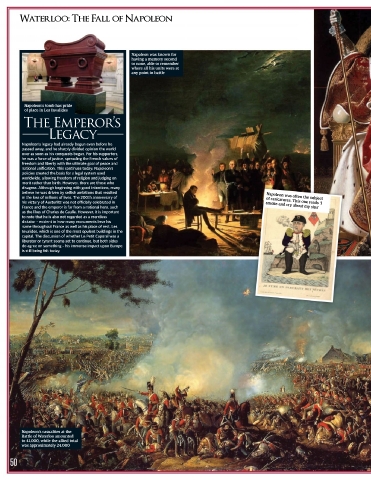
                                               Napoleon was known for
                                               having a memory second
                                               to none, able to remember
                                               where all his units were at
                                               any point in battle


          Napoleon’s tomb has pride
          of place in Les Invalides
         The Emperor’s
                  Legacy

         Napoleon’s legacy had already begun even before he
         passed away, and he sharply divided opinion the world
         over as soon as his conquests began. For his supporters,
         he was a force of justice, spreading the French values of
         freedom and liberty with the ultimate goal of peace and
         national unification. This continues today; Napoleon’s
         policies created the basis for a legal system used
         worldwide, allowing freedom of religion and judging on
         merit rather than birth. However, there are those who
         disagree. Although beginning with good intentions, many
         believe he was driven by selfish ambitions that resulted
         in the loss of millions of lives. The 200th anniversary of                            Napoleon was often the subject
         his victory of Austerlitz was not officially celebrated in                            of caricatures. This one reads ‘I
         France and the emperor is far from a national hero, such                             smoke and cry about my sins’
         as the likes of Charles de Gaulle. However, it is important
         to note that he is also not regarded as a merciless
         dictator – evident in how many monuments bear his
         name throughout France as well as his place of rest, Les
         Invalides, which is one of the most opulent buildings in the
         capital. The discussion of whether Le Petit Caporal was a
         liberator or tyrant seems set to continue, but both sides
         do agree on something – his immense impact upon Europe
         is still being felt today.


         Napoleon’s casualties at the
         Battle of Waterloo amounted
         to 41,000, while the allied total
         was approximately 24,000

     50

