


Page 53 - All About History - Issue 26-15
P. 53
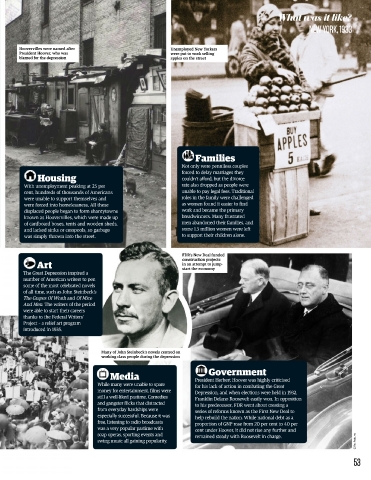
What was it like?
                                                                                                              NEW YORK, 1933


        Hoovervilles were named after                        Unemployed New Yorkers
        President Hoover, who was                            were put to work selling
        blamed for the depression                            apples on the street


                                                                      Families

                                                                 Not only were penniless couples
              Housing                                            forced to delay marriages they
                                                                 couldn’t afford, but the divorce
          With unemployment peaking at 25 per                    rate also dropped as people were
          cent, hundreds of thousands of Americans               unable to pay legal fees. Traditional
          were unable to support themselves and                  roles in the family were challenged
          were forced into homelessness. All these               as women found it easier to find
          displaced people began to form shantytowns             work and became the primary
          known as Hoovervilles, which were made up              breadwinners. Many frustrated
          of cardboard boxes, tents and wooden sheds,            men abandoned their families, and
          and lacked sinks or cesspools, so garbage              some 1.5 million women were left
          was simply thrown into the street.                     to support their children alone.


              Art                                                FDR’s New Deal funded
                                                                 construction projects
                                                                 in an attempt to jump-
         The Great Depression inspired a                         start the economy
         number of American writers to pen
         some of the most celebrated novels
         of all time, such as John Steinbeck’s
         The Grapes Of Wrath and Of Mice
         And Men. The writers of the period
         were able to start their careers
         thanks to the Federal Writers’
         Project – a relief art program
         introduced in 1935.


                                     Many of John Steinbeck’s novels centred on
                                     working class people during the depression

                                        Media                             Government

                                   While many were unable to spare    President Herbert Hoover was highly criticised
                                                                      for his lack of action in combating the Great
                                   money for entertainment, films were   Depression, and when elections were held in 1932,
                                   still a well-liked pastime. Comedies   Franklin Delano Roosevelt easily won. In opposition
                                   and gangster flicks that distracted   to his predecessor, FDR went about creating a
                                   from everyday hardships were       series of reforms known as the First New Deal to
                                   especially successful. Because it was   help rebuild the nation. While national debt as a
                                   free, listening to radio broadcasts   proportion of GNP rose from 20 per cent to 40 per
                                   was a very popular pastime with    cent under Hoover, it did not rise any further and
                                   soap operas, sporting events and   remained steady with Roosevelt in charge.
                                   swing music all gaining popularity.                                                        © Rex Features


                                                                                                                             53

