


Page 55 - All About History - Issue 26-15
P. 55
LENIN'S BLOODY REVOLUTION


               THE ROAD TO
               REVOLUTION

               O May 1896
                Nicholas II is crowned
                tsar, making clear
                he’ll continue the
                autocratic rule of
                Alexander III.
                  O July 1903
                The Russian Social
                Democrat party splits
                into two factions:
                the Bolsheviks,
                under Lenin, and the
                Mensheviks.
                  O January 1905
                Tsarist troops open
                fire on demonstrators
                in Saint Petersburg,
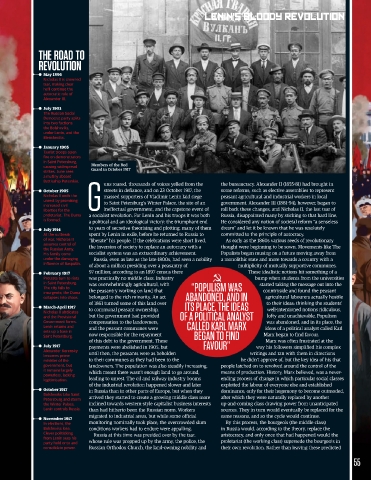
                causing widespread   Members of the Red
                strikes. June sees   Guard in October 1917
                a mutiny aboard
                Battleship Potemkin.
                                     uns roared, thousands of voices yelled from the   the bureaucracy. Alexander II (1855-81) had brought in
                  O October 1905     streets in defiance, and on 23 October 1917, the   some reforms, such as elective assemblies to represent
                Nicholas II ends the   massed supporters of Vladimir Lenin laid siege   peasant agricultural and industrial workers in local
                unrest by promising
                increased civil      to Saint Petersburg’s Winter Palace, the site of an   government. Alexander III (1881-94), however, began to
                liberties for the   G ineffectual government, and the capstone event of   roll back these changes, and Nicholas II, the last tsar of
                proletariat. The Duma   a socialist revolution. For Lenin and his troops it was both   Russia, disappointed many by sticking to that hard line.
                is formed.
                                a political and an ideological victory: the triumphant end   He considered any notion of societal reform “a senseless
                                to years of secretive theorising and plotting, many of them   dream” and let it be known that he was resolutely
                  O July 1914
                At the outbreak   spent by Lenin in exile, before he returned to Russia to   committed to the principle of autocracy.
                of war, Nicholas II   “liberate” his people. If the celebrations were short lived,   As early as the 1860s various seeds of revolutionary
                assumes control of
                the Russian Army.   the inversion of society to replace an autocracy with a   thought were beginning to be sown. Movements like The
                His family come   socialist system was an extraordinary achievement.    Populists began musing on a future moving away from
                under the damaging   Russia, even as late as the late-1800s, had seen a nobility   a monolithic state and more towards a country with a
                influence of Rasputin.
                                of about a million presiding over a peasantry of     multiplicity of mutually supportive communes.
                  O February 1917  97 million; according to an 1897 census there        These idealistic notions hit something of a
                Protests turn to riots   was practically no middle class. Industry         bump when students from the universities
                in Saint Petersburg.   was overwhelmingly agricultural, with                started taking the message out into the
                The city falls to                                   “POPULISM WAS
                insurgents; the Duma   the peasantry working on land that                    countryside and found the peasant
                collapses into chaos.   belonged to the rich minority. An act   ABANDONED, AND IN   agricultural labourers actually hostile
                                of 1861 turned some of this land over                          to their ideas: thinking the students’
                  O March-April 1917                              ITS PLACE, THE IDEAS
                Nicholas II abdicates   to communal peasant ownership,                         well-intentioned notions ridiculous,
                and the Provisional   but the government had provided   OF A POLITICAL ANALYST   lofty and unachievable. Populism
                Government forms.   compensation to the landowners,                            was abandoned, and in its place, the
                Lenin returns and   and the peasant communes were   CALLED KARL MARX          ideas of a political analyst called Karl
                sets up a base in
                Saint Petersburg.  now responsible for the repayment   BEGAN TO FIND          Marx began to find favour.
                                of this debt to the government. These                         Marx was often frustrated at the
                  O July 1917   payments were abolished in 1905, but    FAVOUR”            way his followers simplified his complex
                Alexander Kerensky
                becomes prime   until then, the peasants were as beholden                writings and ran with them in directions
                minister of the   to their communes as they had been to the           he didn’t approve of, but the key idea of his that
                government, but   landowners. The population was also steadily increasing,   people latched on to revolved around the control of the
                it remains largely   which meant there wasn’t enough land to go around,   means of production. History, Marx believed, was a never-
                powerless, lacking
                legitimisation.  leading to unrest. The oil and railway industry booms   ending process of change in which particular social classes
                                of the industrial revolution happened slower and later   exploited the labour of everyone else and established
                  O October 1917  in Russia than in other parts of Europe, but when they   dominance, only for their hegemony to become outmoded,
                Bolsheviks take Saint
                Petersburg and storm   arrived they started to create a growing middle class more   after which they were naturally replaced by another
                the Winter Palace.   inclined towards western-style capitalist business interests   up-and-coming class drawing power from unanticipated
                Lenin controls Russia.  than had hitherto been the Russian norm. Workers   sources. They in turn would eventually be replaced for the
                                migrated to industrial areas, but while some official   same reasons, and so the cycle would continue.
                  O November 1917
                In elections, the   monitoring nominally took place, the overcrowded slum   By this process, the bourgeois (the middle class)
                Bolsheviks lose.   conditions workers had to endure were appalling.   in Russia would, according to the theory, replace the
                Clever politicking   Russia at this time was presided over by the tsar,   aristocracy, and only once that had happened would the
                from Lenin sees his
                party hold onto and   whose rule was propped up by the army, the police, the   proletariat (the working class) supersede the bourgeois in
                consolidate power.  Russian Orthodox Church, the land-owning nobility and   their own revolution. Rather than leaving these predicted
                                                                                                                             55

