


Page 70 - All About History - Issue 26-15
P. 70
Nefertiti: The Queen who killed the gods


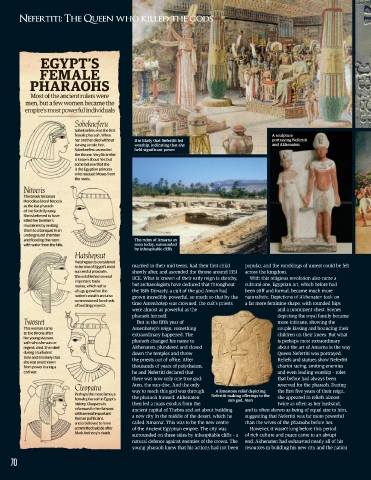
                                                                                                 A sculpture
                                                It is likely that Nefertiti led                  portraying Nefertiti
                                                worship, indicating that she                     and Akhenaten
                                                held significant power


                                                The ruins of Amarna as
                                                seen today, surrounded
                                                by inhospitable cliffs


                                               married in their mid teens, had their first child   popular, and the rumblings of unrest could be felt
                                               shortly after, and ascended the throne around 1351   across the kingdom.
                                               BCE. What is known of their early reign is sketchy,   With this religious revolution also came a
                                               but archaeologists have deduced that throughout   cultural one. Egyptian art, which before had
                                               the 18th Dynasty, a cult of the god Amun had   been stiff and formal, became much more
                                               grown incredibly powerful, so much so that by the   naturalistic. Depictions of Akhenaten took on
                                               time Amenhotep was crowned, the cult’s priests   a far more feminine shape, with rounded hips
                                               were almost as powerful as the                      and a prominent chest. Scenes
                                               pharaoh himself.                                    depicting the royal family became
                                                 But in the fifth year of                          more intimate, showing the
                                               Amenhotep’s reign, something                        couple kissing and bouncing their
                                               extraordinary happened. The                         children on their knees. But what
                                               pharaoh changed his name to                         is perhaps most extraordinary
                                               Akhenaten, plundered and closed                     about the art of Amarna is the way
                                               down the temples and threw                          Queen Nefertiti was portrayed.
                                               the priests out of office. After                    Reliefs and statues show Nefertiti
                                               thousands of years of polytheism,                   chariot racing, smiting enemies
                                               he and Nefertiti declared that                      and even leading worship – roles
                                               there was now only one true god:                    that before had always been
                                               Aten, the sun-disc. And the only                    reserved for the pharaoh. During
                                               way to reach this god was through  A limestone relief depicting   the first five years of their reign,
                                               the pharaoh himself. Akhenaten   Nefertiti making offerings to the   she appeared in reliefs almost
                                                                                 sun god, Aten
                                               then led a mass exodus from the                     twice as often as her husband,
                                               ancient capital of Thebes and set about building  and is often shown as being of equal size to him,
                                               a new city in the middle of the desert, which he   suggesting that Nefertiti was far more powerful
                                               called ‘Amarna’. This was to be the new centre   than the wives of the pharaohs before her.
                                               of the Ancient Egyptian empire. The city was   However, it wasn’t long before this period
                                               surrounded on three sides by inhospitable cliffs – a   of rich culture and peace came to an abrupt
                                               natural defence against enemies of the crown. The   end. Akhenaten had exhausted nearly all of his
                                               young pharaoh knew that his actions had not been   resources in building his new city and the nation
     70

