


Page 75 - All About History - Issue 26-15
P. 75
THE CATALAUNIAN


                                                                         PLAINS


                                                    CHAMPAGNE-ARDENNE REGION, FRANCE 20 JUNE 451


                                                    he Battle of the Catalaunian Plains (or the   former to form an alliance with the Roman empire.
                                                    Battle of Chalons, as it is sometimes referred   Thus, Aetius and his troops, along with an alliance
                                                    to) played host to a skirmish between two   of Visigoths led by King Theodoric I and groups of
                                                    opponents experiencing varying fortunes.   Alans and Burgundinians, made for Orleans.
                                               T On one side was the Roman Empire, a once-  As it turned out, they made it just in time, on 14
                                               mighty force on the wane in the wake of constant   June, with Orleans on the verge of surrender. Despite
                                               assaults courtesy of increasingly powerful tribes   the fact that his forces greatly outnumbered the
                                               from across Europe. On the other was one of the   Roman coalition, Attila ordered his troops to retreat
                                               chief perpetrators of said attacks: Attila the Hun.  in good order, preferring to face them in open battle
                                                 Known as ‘the scourge of God’, Attila and his   rather than the confines of the city. Making camp
                                               Huns inspired great fear, and for good reason.   near Chalons, he waited until the cover of darkness.
                                               He and his tribe were renowned for the manner   All the while Aetius and his force remained in battle
                                               in which they swept through the eastern   formation. On 20 June, the fighting commenced.
                                               Roman Empire, laying waste to all in their path,   The battle was one of the bloodiest fought of
                                               indiscriminate of age, race or rank. And they were   that age. Although Attila took the early upper hand,
                                               looking for a new target, ultimately settling on Gaul   ploughing through the soft centre of the Alans
                                               (now France). Although nominally counted as part   (purposefully placed there due to their unreliability),
                                               of the Roman Empire, in actuality it was largely   the Romans and Visigoths returned fire by attacking
                                               controlled by the Visigoths, who found themselves   the flanks, turning the tide of the battle. With light
                                               under threat from Attila. The barbarian rampaged   returning and his life at risk, Attila again withdrew.
                                               through Gaul, with cities like Cologne, Mainz, Metz,   Exact numbers of the dead (including Theodoric
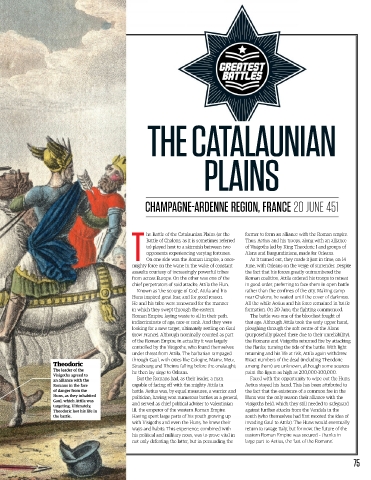
                    Theodoric                  Strasbourg and Rheims falling before the onslaught;   among them) are unknown, although some sources
                    The leader of the
                    Visigoths agreed to        he then lay siege to Orleans.           paint the figure as high as 200,000-300,000.
                    an alliance with the         But the Romans had, as their leader, a man   Faced with the opportunity to wipe out the Huns,
                    Romans in the face         capable of facing off with the mighty Attila in   Aetius stayed his hand. This has been attributed to
                    of danger from the         battle. Aetius was, by equal measures, a warrior and   the fact that the existence of a common foe in the
                    Huns, as they inhabited    politician, having won numerous battles as a general,   Huns was the only reason their alliance with the
                    Gaul, which Attila was
                    targeting. Ultimately,     and served as chief political adviser to Valentinian   Visigoths held, which they still needed to safeguard
                    Theodoric lost his life in   III, the emperor of the western Roman Empire.   against further attacks from the Vandals in the
                    the battle.                Having spent large parts of his youth growing up   south (who themselves had first mooted the idea of
                                               with Visigoths and even the Huns, he knew their   invading Gaul to Attila). The Huns would eventually
                                               ways and habits. This experience, combined with   return to ravage Italy, but for now, the future of the
                                               his political and military nous, was to prove vital in   eastern Roman Empire was secured – thanks in
                                               not only defeating the latter, but in persuading the   large part to Aetius, the ‘last of the Romans’.


                                                                                                                             75

