


Page 82 - All About History - Issue 26-15
P. 82
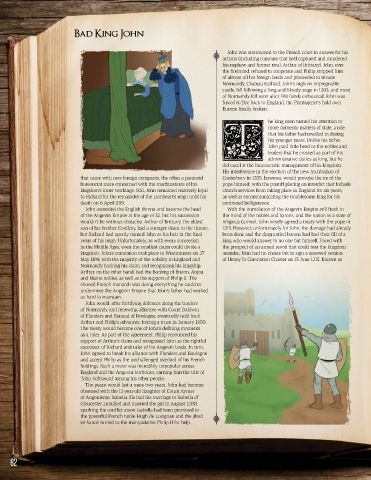
Bad King John


                                                                                 John was summoned to the French court to answer for his
                                                                               actions (including rumours that he’d captured and murdered
                                                                               his nephew and former rival, Arthur of Brittany). John, ever
                                                                               the firebrand, refused to cooperate and Philip stripped him
                                                                               of almost all his foreign lands and proceeded to invade
                                                                               Normandy. Chateau Gaillard, John’s nigh on impregnable
                                                                               castle, fell following a long and bloody siege in 1203, and most
                                                                               of Normandy fell soon after. His funds exhausted, John was
                                                                               forced to flee back to England, the Plantagenet’s hold over
                                                                               Europe finally broken.

                                                                                               he king soon turned his attention to
                                                                                               more domestic matters of state, a role
                                                                                               that his father had revelled in during
                                                                                               his younger years. Unlike his father,
                                                                                               John paid little heed to the nobles and
                                                                                               leaders that he crossed as part of his
                                                                               T administrative duties as king, but he
                                                                               did excel at the bureaucratic management of his kingdom.
                                                                               His interference in the election of the new Archbishop of
                             that came with new foreign conquests, the other a paranoid   Canterbury in 1205, however, would provoke the ire of the
                             bureaucrat more concerned with the machinations of his   pope himself, with the pontiff placing an interdict that forbade
                             kingdom’s inner workings. Still, John remained relatively loyal   church services from taking place in England for six years,
                             to Richard for the remainder of the Lionheart’s reign until his   as well as excommunicating the troublesome king for his
                             death on 6 April 1199.                            continued belligerence.
                               John ascended the English throne and became the head   With the immolation of the Angevin Empire still fresh in
                             of the Angevin Empire at the age of 32, but his succession   the mind of the nobles and barons, and the nation in a state of
                             wouldn’t be without obstacles. Arthur of Brittany, the eldest   religious turmoil, John wisely agreed a treaty with the pope in
                             son of his brother Geoffrey, had a stronger claim to the throne,   1213. However, unfortunately for John, the damage had already
                             but Richard had openly named John as his heir in the final   been done and the disgruntled barons had had their fill of a
                             years of his reign. Unfortunately, as with every succession   king who would answer to no one but himself. Faced with
                             in the Middle Ages, even the smallest claim could divide a   the prospect of an armed revolt that could tear the kingdom
                             kingdom. John’s coronation took place in Westminster on 27   asunder, John had no choice but to sign a renewed version
                             May 1199, with the majority of the nobility in England and   of Henry I’s Coronation Charter on 15 June 1215. Known as
                             Normandy backing his claim and recognising his kingship.
                             Arthur, on the other hand, had the backing of Breton, Anjou
                             and Maine nobles, as well as the support of Philip II. The
                             shrewd French monarch was doing everything he could to
                             undermine the Angevin Empire that John’s father had worked
                             so hard to maintain.
                               John would, after fortifying defences along the borders
                             of Normandy and renewing alliances with Count Baldwin
                             of Flanders and Renaud of Boulogne, eventually hold back
                             Arthur and Philip’s advances, forcing a truce in January 1200.
                             The treaty would become one of John’s defining moments
                             as a ruler. As part of the agreement, Philip renounced his
                             support of Arthur’s claim and recognised John as the rightful
                             successor of Richard and ruler of his Angevin lands. In turn,
                             John agreed to break his alliance with Flanders and Boulogne
                             and accept Philip as the unchallenged overlord of his French
                             holdings. Such a move was incredibly unpopular across
                             England and the Angevin territories, earning him the title of
                             ‘John Softsword’ among his other people.
                               The peace would last a mere two years. John had become
                             obsessed with the 12-year-old daughter of Count Aymer
                             of Angouleme, Isabella. He had his marriage to Isabella of
                             Gloucester annulled and married the girl in August 1200,
                             sparking the conflict anew. Isabella had been promised to
                             the powerful French noble Hugh de Lusignan and the jilted
                             ex-fiancé turned to the manipulative Philip II for help.


     82

