


Page 83 - All About History - Issue 26-15
P. 83
BadKingJohn


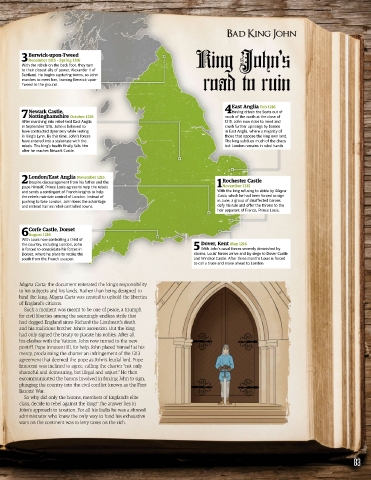
           Berwick-upon-Tweed
         3 December 1215 – Spring 1216
         With the rebels on the back foot, they turn
         to their closest ally of power, Alexander II of
         Scotland. He begins capturing towns, so John
         marches to meet him, burning Berwick-upon-
         Tweed to the ground.


                                                                                  East Anglia Feb 1216
           Newark Castle,                                                       4Having driven the Scots out of
         7Nottinghamshire October 1216                                          much of the north at the close of
         After marching into rebel-held East Anglia                             1215, John now rides to meet and
         in September 1216, John is believed to                                 crush further uprisings by barons
         have contracted dysentery while resting                                in East Anglia, where a majority of
         in King’s Lynn. By this time, John’s forces                            those that oppose the king own land.
         have entered into a stalemate with the                                 The king subdues much of the chaos
         rebels. The king’s health finally fails him                            but London remains in rebel hands.
         after he reaches Newark Castle.


           London/East Anglia November 1215
         2 Despite discouragement from his father and the                      Rochester Castle
         pope himself, Prince Louis agrees to help the rebels                1November 1215
         and sends a contingent of French knights to help                    With the king refusing to abide by Magna
         the rebels maintain control of London. Instead of                   Carta, which he had been forced to sign
         pushing to take London, John loses the advantage                    in June, a group of disaffected barons
         and instead harries rebel-controlled towns.                         defy his rule and offer the throne to the
                                                                             heir apparent of France, Prince Louis.


           Corfe Castle, Dorset
         6August 1216
         With Louis now controlling a third of
         the country, including London, John                            Dover, Kent May 1216
         is forced to consolidate his forces in                      5 With John’s naval forces severely diminished by
         Dorset, where he plans to retake the                        storms, Louis’ forces arrive and lay siege to Dover Castle
         south from the French usurper.                              and Windsor Castle. After three months Louis is forced
                                                                     to call a truce and move ahead to London.


        Magna Carta, the document reiterated the king’s responsibility
        to his subjects and his lands. Rather than being designed to
        bind the king, Magna Carta was created to uphold the liberties
        of England’s citizens.
          Such a moment was meant to be one of peace, a triumph
        for civil liberties among the seemingly endless strife that
        had dogged England since Richard the Lionheart's death
        and his malicious brother John’s ascension. But the king
        had only signed the treaty to placate his nobles. After all
        his clashes with the Vatican, John now turned to the new
        pontiff, Pope Innocent III, for help. John placed himself at his
        mercy, proclaiming the charter an infringement of the 1213
        agreement that deemed the pope as John’s feudal lord. Pope
        Innocent was inclined to agree, calling the charter “not only
        shameful and demeaning, but illegal and unjust.” He then
        excommunicated the barons involved in forcing John to sign,
        plunging the country into the civil conflict known as the First
        Barons’ War.
          So why did only the barons, members of England’s elite
        class, decide to rebel against the king? The answer lies in
        John’s approach to taxation. For all his faults he was a shrewd
        administrator who knew the only way to fund his exhaustive
        wars on the continent was to levy taxes on the rich.


                                                                                                                             83

