


Page 84 - All About History - Issue 26-15
P. 84
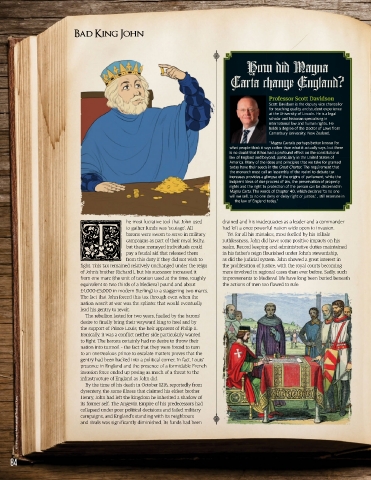
Bad King John


                                             he most lucrative tool that John used  drained and his inadequacies as a leader and a commander
                                             to gather funds was ‘scutage’. All   had left a once powerful nation wide open to invasion.
                                             barons were sworn to serve in military   Yet for all his mistakes, most fuelled by his telltale
                                             campaigns as part of their royal fealty,   ruthlessness, John did have some positive impacts on his
                                             but these moneyed individuals could   realm. Record keeping and administrative duties maintained
                                             pay a feudal aid that released them   in his father’s reign flourished under John’s stewardship,
                             T from this duty if they did not wish to          as did the judicial system. John showed a great interest in
                             fight. This tax remained relatively unchanged under the reign   the proliferation of justice, with the royal courts becoming
                             of John’s brother Richard I, but his successor increased it   more involved in regional cases than ever before. Sadly, such
                             from one marc (the unit of taxation used at the time, roughly   improvements to Medieval life have long been buried beneath
                             equivalent to two thirds of a Medieval pound and about   the actions of men too flawed to rule.
                             £4,000-£5,000 in modern Sterling) to a staggering two marcs.
                             The fact that John forced this tax through even when the
                             nation wasn’t at war was the splinter that would eventually
                             lead his gentry to revolt.
                               The rebellion lasted for two years, fuelled by the barons’
                             desire to finally bring their wayward king to heel and by
                             the support of Prince Louis, the heir apparent of Philip II.
                             Ironically, it was a conflict neither side particularly wanted
                             to fight. The barons certainly had no desire to throw their
                             nation into turmoil – the fact that they were forced to turn
                             to an overzealous prince to escalate matters proves that the
                             gentry had been backed into a political corner. In fact, Louis’
                             presence in England and the presence of a formidable French
                             invasion force ended up posing as much of a threat to the
                             infrastructure of England as John did.
                               By the time of his death in October 1216, reportedly from
                             dysentery, the same illness that claimed his eldest brother
                             Henry, John had left the kingdom he inherited a shadow of
       © Illustrations by Rebekka Hearl ; Thinkstock; Alamy  collapsed under poor political decisions and failed military
                             its former self. The Angevin Empire of his predecessors had
                             campaigns, and England’s standing with its neighbours
                             and rivals was significantly diminished. Its funds had been


     84

