


Page 88 - All About History - Issue 26-15
P. 88
Reviews


          SHACKLETON’S HEROES


          Survival of the South Pole’s unsung heroes

          Author Wilson McOrist Publisher The Robson Press Price £20 (hardback) Released Out now
               fter eight years of research, physicist and   diaries, from religious faith to the promise of seeing a
               lawyer Wilson McOrist has pieced together   loved one’s face again.
               the memories of the explorers at one of the   Forget Bear Grylls or any reality TV island show: there
               last great frontiers of the 20th century. It’s not   was no time-out or easy exit when the going got too
          Athe story of Sir Ernest Shackleton’s Imperial   tough for these guys. This is a story of a real struggle to
          Trans-Antarctic expedition, however. This is the tale   survive, and McOrist’s efforts to give each a voice after a
          of those who braved one of the world’s most hostile   century of silence has paid off with a gripping read.
          environments to leave supplies for Shackleton.   Ben Biggs
            Key to McOrist’s book are the diaries of the men
          involved, without which it would feel distinctly less
          personal. Their characters are summarised, events
          explained and the nuances of the language they use
          (that, given the class differences and backgrounds of
          the men, can vary greatly) are parsed for the sake of
          modern understanding, but that’s no replacement for
          the authenticity of their own words. So, for the best
          part, McOrist allows them to tell the story themselves.
            And what a story. In the awful hardships that
          followed their arrival at their Antarctic base camp,
          personalities clash, tempers fray and morale spikes
          then dips with terrible sub-zero temperatures. As
          the men are worn down by conditions that early-
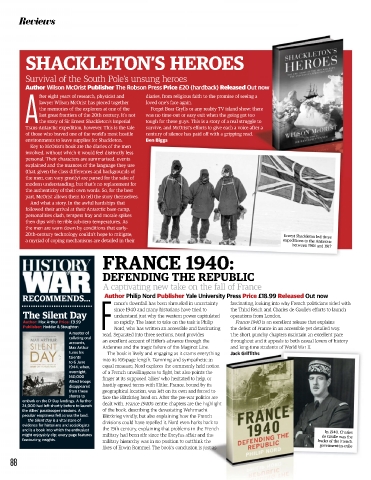
          20th-century technology couldn’t hope to mitigate,                                         Ernest Shackleton led three
          a myriad of coping mechanisms are detailed in their                                        expeditions to the Antarctic
                                                                                                        between 1901 and 1917
                                     FRANCE 1940:


                                     DEFENDING THE REPUBLIC
                                     A captivating new take on the fall of France

         RECOMMENDS…                  Author Philip Nord Publisher Yale University Press Price £18.99 Released Out now
                                         rance’s downfall has been shrouded in uncertainty  fascinating, looking into why French politicians sided with
                                         since 1940 and many historians have tried to  theThirdReichandCharlesdeGaulle’seffortstolaunch
         The Silent Day                  understand just why the western power capitulated  operations from London.
         Author: Max Arthur Price: £9.99   sorapidly.ThelatesttotakeonthetaskisPhilip  France 1940 is an excellent release that explains
         Publisher: Hodder & Stoughton
                                    F Nord, who has written an accessible and fascinating  thedefeatofFranceinanaccessibleyetdetailedway.
                         Amasterof   read. Separated into three sections, Nord provides  Theshort,punchychaptersmaintainanexcellentpace
                         collating oral
                         accounts,   an excellent account of Hitler’s advance through the  throughout and it appeals to both casual lovers of history
                         Max Arthur   Ardennes and the tragic failure of the Maginot Line  andlongtimestudentsofWorldWarII.
                         turns his     Thebookislivelyandengagingasitcramseve
                         talents
                         to 6 June   into its 166-page length. Damning and sympathet
                         1944, when,   equalmeasure,Nordexploresthecommonlyheld
                         overnight,   of a French unwillingness to fight, but also points
                         160,000     fingeratitssupposed‘allies’whohesitatedtohelp
                         Allied troops
                         disappeared   hastilyagreedtermswithHitler.France,boundb
                         from these   geographical location, was left on its own and for
                         shores to   facetheBlitzkriegheadon.Afterthepre-warpoli
         embark on the D-Day landings. A further
         24,000 had left shortly before to launch   dealt with, France 1940’s centre chapters are the
         the Allies’ paratrooper missions. A   of the book, describing the devastating Wehrmac
         peculiar emptiness fell across the land.   Blitzkriegvividly,butalsoexplaininghowtheFre
           The Silent Day is a vital store of
         evidence for historians and sociologists   divisionscouldhaverepelledit.Nordevenharks
         and is a book into which the enthusiast   the19thcentury,explainingthatproblemsinthe
                                                                                                                   In 1940, Charles
         might enjoyably dip; every page features   military had been rife since the Dreyfus affair and           de Gaulle was the
         fascinating insights.
                                     military hierarchy was in no position to outthink                           leader of the French
                                     likes of Erwin Rommel. The book’s conclusion is                             goverment-in-exile
     88

