


Page 61 - Aviation News (February 2020)
P. 61
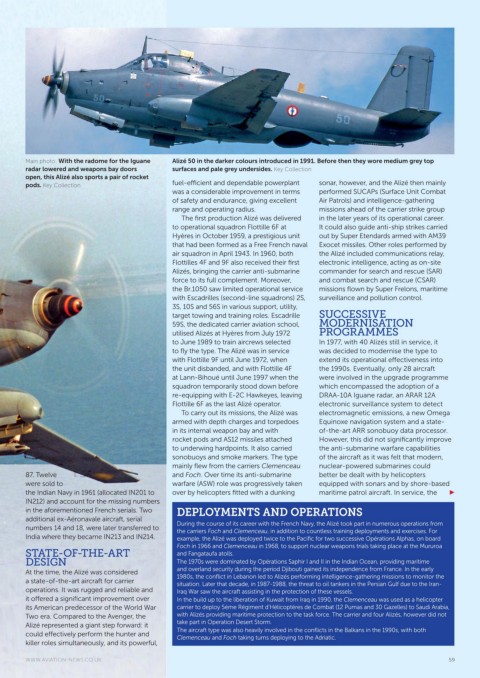
Main photo: With the radome for the Iguane   Alizé 50 in the darker colours introduced in 1991. Before then they wore medium grey top
           radar lowered and weapons bay doors   surfaces and pale grey undersides. Key Collection
           open, this Alizé also sports a pair of rocket
           pods. Key Collection                 fuel-e   cient and dependable powerplant   sonar, however, and the Alizé then mainly
                                                was a considerable improvement in terms   performed SUCAPs (Surface Unit Combat
                                                of safety and endurance, giving excellent   Air Patrols) and intelligence-gathering
                                                range and operating radius.         missions ahead of the carrier strike group
                                                  The fi rst production Alizé was delivered   in the later years of its operational career.
                                                to operational squadron Flottille 6F at   It could also guide anti-ship strikes carried
                                                Hyères in October 1959, a prestigious unit   out by Super Etendards armed with AM39
                                                that had been formed as a Free French naval   Exocet missiles. Other roles performed by
                                                air squadron in April 1943. In 1960, both   the Alizé included communications relay,
                                                Flottilles 4F and 9F also received their fi rst   electronic intelligence, acting as on-site
                                                Alizés, bringing the carrier anti-submarine   commander for search and rescue (SAR)
                                                force to its full complement. Moreover,   and combat search and rescue (CSAR)
                                                the Br.1050 saw limited operational service   missions fl own by Super Frelons, maritime
                                                with Escadrilles (second-line squadrons) 2S,   surveillance and pollution control.
                                                3S, 10S and 56S in various support, utility,
                                                target towing and training roles. Escadrille   SUCCESSIVE
                                                59S, the dedicated carrier aviation school,   MODERNISATION
                                                utilised Alizés at Hyères from July 1972   PROGRAMMES
                                                to June 1989 to train aircrews selected   In 1977, with 40 Alizés still in service, it
                                                to fl y the type. The Alizé was in service   was decided to modernise the type to
                                                with Flottille 9F until June 1972, when   extend its operational e  ectiveness into
                                                the unit disbanded, and with Flottille 4F   the 1990s. Eventually, only 28 aircraft
                                                at Lann-Bihoué until June 1997 when the   were involved in the upgrade programme
                                                squadron temporarily stood down before   which encompassed the adoption of a
                                                re-equipping with E-2C Hawkeyes, leaving   DRAA-10A Iguane radar, an ARAR 12A
                                                Flottille 6F as the last Alizé operator.  electronic surveillance system to detect
                                                  To carry out its missions, the Alizé was   electromagnetic emissions, a new Omega
                                                armed with depth charges and torpedoes   Equinoxe navigation system and a state-
                                                in its internal weapon bay and with   of-the-art ARR sonobuoy data processor.
                                                rocket pods and AS12 missiles attached   However, this did not signifi cantly improve
                                                to underwing hardpoints. It also carried   the anti-submarine warfare capabilities
                                                sonobuoys and smoke markers. The type   of the aircraft as it was felt that modern,
                                                mainly fl ew from the carriers Clemenceau   nuclear-powered submarines could
           87. Twelve                           and Foch. Over time its anti-submarine   better be dealt with by helicopters
           were sold to                         warfare (ASW) role was progressively taken   equipped with sonars and by shore-based
           the Indian Navy in 1961 (allocated IN201 to   over by helicopters fi tted with a dunking   maritime patrol aircraft. In service, the
           IN212) and account for the missing numbers
           in the aforementioned French serials. Two   DEPLOYMENTS AND OPERATIONS
           additional ex-Aéronavale aircraft, serial
           numbers 14 and 18, were later transferred to   During the course of its career with the French Navy, the Alizé took part in numerous operations from
                                                 the carriers Foch and Clemenceau, in addition to countless training deployments and exercises. For
           India where they became IN213 and IN214.  example, the Alizé was deployed twice to the Pacifi c for two successive Opérations Alphas, on board
                                                 Foch in 1966 and Clemenceau in 1968, to support nuclear weapons trials taking place at the Mururoa
           STATE-OF-THE-ART                      and Fangataufa atolls.
           DESIGN                                The 1970s were dominated by Opérations Saphir I and II in the Indian Ocean, providing maritime
           At the time, the Alizé was considered   and overland security during the period Djibouti gained its independence from France. In the early
           a state-of-the-art aircraft for carrier   1980s, the confl ict in Lebanon led to Alizés performing intelligence-gathering missions to monitor the
                                                 situation. Later that decade, in 1987-1988, the threat to oil tankers in the Persian Gulf due to the Iran-
           operations. It was rugged and reliable and   Iraq War saw the aircraft assisting in the protection of these vessels.
           it o  ered a signifi cant improvement over   In the build up to the liberation of Kuwait from Iraq in 1990, the Clemenceau was used as a helicopter
           its American predecessor of the World War   carrier to deploy 5ème Régiment d’Hélicoptères de Combat (12 Pumas and 30 Gazelles) to Saudi Arabia,
           Two era. Compared to the Avenger, the   with Alizés providing maritime protection to the task force. The carrier and four Alizés, however did not
           Alizé represented a giant step forward: it   take part in Operation Desert Storm.
           could e  ectively perform the hunter and   The aircraft type was also heavily involved in the confl icts in the Balkans in the 1990s, with both
                                                 Clemenceau and Foch taking turns deploying to the Adriatic.
           killer roles simultaneously, and its powerful,

           WWW.AVIATION NEWS.CO.UK                                                                                   59


       58-62_alizeDC.mfDC.mf.indd   59                                                                           07/01/2020   15:49

