


Page 63 - Aviation News (February 2020)
P. 63
These aircraft, serial                                                                     routinely found
           numbers 56 and                                                                             when the Alizé was
           59, were the ones                                                                          operational and the
           considered to be in                                                                        French Navy had
           the best shape after                                                                       developed specifi c
           many years of open-                                                                        ways to tackle it.
           air storage in Nîmes-                                                                      This know-how
           Garons. Alizé Marine                                                                       is kept alive today
           had also secured                                                                           within the Alizé
           a huge amount of                                                                           Marine team.
           spares and a number
           of Rolls-Royce Dart                                                                        ISSUES TO
           engines, including                                                                         SOLVE
           some that had not                                                                          The major sub-
           fl own since coming                                                                         components
           out of overhaul. The                                                                       – landing gear,
           Atelier Industriel                                                                         arresting hook,
           Aéronautique (AIA),                                                                        radome, radar and
           the depot which                                                                            engine – were
           handled all Alizé third-line inspections,   The Alizé was able to take o   from French   all removed from the airframe to allow
           provided outstanding support, helping   carriers without using the catapult, although   all the structure to be closely inspected.
                                                it was used here – note the launch bridle at
           source precious spares inventories.                                      Eric Nevers, one of the engineers, then
                                                the end of the cat track. Henri-Pierre Grolleau
                                                                                    overhauled the hydraulic systems,
           ALIZÉS 56 AND 59                     project and were willing to help. The Marine   methodically checking the various
           Alizé Marine engineers began working on   Nationale also provided tooling and lifting   components including the pumps that
           the aircraft in Nîmes-Garons under the   gear as and when required.      operate the landing gear and the tailhook.
           leadership of Patrice Bats, a very experienced   The fi rst hurdle to overcome was the   The radome and the doors of the weapons
           ex-navy engineer who had spent years   strict French regulations on asbestos. This   bay have been made fully operable again, a
           working on the Alizé during his career in the   problem in the hangar was quickly cleared,   good thing for airshow displays.
           military. Patrice had managed to gather a   however, and the engineers soon turned   As is often the case with such projects,
           team of former navy specialists who had all   their attention to the airframe. Although   issues did appear and had to be solved.
           the required skills to handle the project.  the aircraft had been kept in open storage   According to Jean-Jacques Jourdan, an
              They fi rst surveyed the two aircraft   for quite a while, very little corrosion was   electrician/avionics specialist by trade,
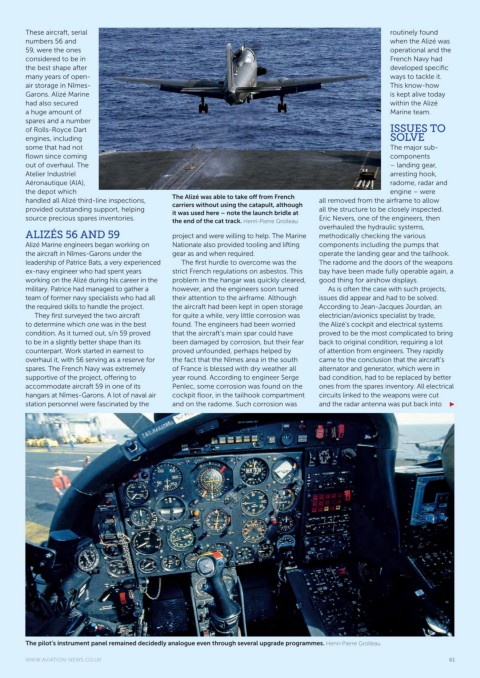
           to determine which one was in the best   found. The engineers had been worried   the Alizé’s cockpit and electrical systems
           condition. As it turned out, s/n 59 proved   that the aircraft’s main spar could have   proved to be the most complicated to bring
           to be in a slightly better shape than its   been damaged by corrosion, but their fear   back to original condition, requiring a lot
           counterpart. Work started in earnest to   proved unfounded, perhaps helped by   of attention from engineers. They rapidly
           overhaul it, with 56 serving as a reserve for   the fact that the Nîmes area in the south   came to the conclusion that the aircraft’s
           spares. The French Navy was extremely   of France is blessed with dry weather all   alternator and generator, which were in
           supportive of the project, o  ering to   year round. According to engineer Serge   bad condition, had to be replaced by better
           accommodate aircraft 59 in one of its   Penlec, some corrosion was found on the   ones from the spares inventory. All electrical
           hangars at Nîmes-Garons. A lot of naval air   cockpit fl oor, in the tailhook compartment   circuits linked to the weapons were cut
           station personnel were fascinated by the   and on the radome. Such corrosion was   and the radar antenna was put back into


           The pilot’s instrument panel remained decidedly analogue even through several upgrade programmes. Henri-Pierre Grolleau

           WWW.AVIATION NEWS.CO.UK                                                                                   61


       58-62_alizeDC.mfDC.mf.indd   61                                                                           07/01/2020   15:49

