


Page 198 - (DK Eyewitness) Travel Guide - Portugal
P. 198
4 "
        Sé Nova
        ⌂ Largo da Sé Nova
        § 239 823 138   # 9:30am–
        6pm Mon–Sat, 10am–
        12:30pm Sun
        Nova, or new, is a relative term,
      EXPERIENCE  The Beiras  the Jesuits in 1598. Located a   Paths leading up to an ornate stone
        as this church was founded by
        short walk from the university,
        their adjacent Colégio das
        Onze Mil Virgens is today part
        of the sciences faculty. The
        Jesuit Order was banned by
        the Marquês de Pombal in
        1759 but their church became
                                                The university is still a centre
        the episcopal seat in 1772.   5 fountain in the Jardim Botânico
        Jesuit saints still look out            for the study of flora.
        from the façade.    Jardim Botânico       The entrance, near the
          The interior, more spacious   ⌂ Calçada Martim de   16th-century aqueduct of São
        than the Sé Velha (p196), is   Freitas   § 239 855 215      Sebastião, leads into 20 ha
        barrel-vaulted, with a dome   # Apr–Sep: 9am–8pm daily;   (50 acres) devoted to a
        over the crossing. To the left   Oct–Mar: 9am–5:30pm daily  remarkable collection of some
        of the entrance is a Manueline-         1,200 plants, including many
        style octagonal font brought,   These, Portugal’s largest   rare and exotic species. The
        with the choir stalls, from the   botanical gardens, were   gardens are used for research,
        Sé Velha. The paintings above   created in 1772 when the   but are laid out as pleasure
        the stalls are copies of Italian   reforming Marquês de   gardens, with greenhouses
        masters. The altar piece in the   Pombal (p45) introduced    and a wild area overlooking
        17th-century chancel,   the study of natural history    the Mondego river.
        featuring more Jesuit saints,     at the University of Coimbra.
        is flanked by a pair of 18th-
        century organs.
                                                6 "
                                                Santa Clara-a-Nova
                                                ⌂ Alto de Santa Clara
                                                § 239 441 674   # Apr–Sep:
                                                10am–7pm daily (to 6pm
                                                Oct–Mar)
                                                The vast “new” convent of the
                                                Poor Clares was built between
                                                1649 and 1677 to house the
                                                nuns from Santa Clara-a-Velha
                                                (p199) on drier land uphill. The
                                                building was designed by a
                                                mathematics professor, João
                                                Turriano, and although
                                                intended as a convent, now
                                                serves in part as a barracks
                                                for the army.
                                                  In the richly Baroque
                                                church, pride of place is given
                                                to the silver tomb of Santa
                                                Isabel, installed in 1696 and


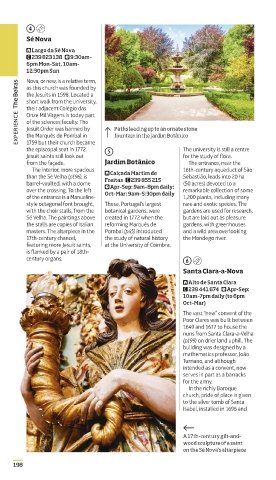
                                                A 17th-century gilt-and-
                                                wood sculpture of a saint
                                                on the Sé Nova’s altarpiece
    198


   196-199_EW_Portugal.indd   198                            20/09/2018   10:40


 EW Must-see template v2 – 12th July 2018
 Fonts: Aptifer Sans LT Pro, Posterama Text, Soho Gothic
 Pro, Soho Pro, ITC Caslon 224

