


Page 262 - (DK Eyewitness) Travel Guide - Portugal
P. 262
THE STORY OF PORT
The “discovery” of port dates from the STYLES OF PORT
17th century, when British merchants Tawny
added brandy to the wine of the north ern Quality tawny port is
Douro region to prevent it souring in transit. matured in oak casks
They found that the stronger and sweeter in port lodges. It may
be a blend of red and
the wine, the better flavour it acquired.
EXPERIENCE Douro and Trás-os-Montes The climax of the Douro farmers’ year comes Deep red in colour, this
white ports.
HOW PORT IS MADE
Ruby Port
port has been aged
in late Septem ber, when bands of pickers
two or three years
congregate to harvest the grapes. More than
and should be full of
40 varieties are used for making port, but
lively fruit flavour.
there are five recommended varieties. The
grapes are then either tread in stone tanks (or
White Port
lagares) to extract the juice or fermented in
cement or steel tanks. Next comes the for
Made from white
grapes, this beverage
tification process, where brandy – actually
grape spirit – is added. This arrests the fermen
may be sweet or not
so sweet and is mainly
ta tion, leaving the wine naturally sweet.
drunk chilled.
Vintage
Made from wines of a
single year, the liquid
is blended and bottled
after two years and
left to mature.
Late Bottled Vintage
LBV is a wine of a
single year, bottled
between four and
six years after
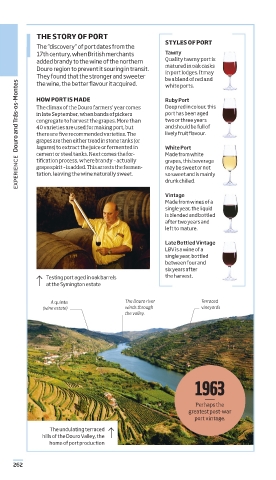
Testing port aged in oak barrels the harvest.
at the Symington estate
A quinta The Douro river Terraced
(wine estate) winds through vineyards
the valley.
1963
Perhaps the
greatest postwar
port vintage.
The undulating terraced
hills of the Douro Valley, the
home of port production
262
262-263_EW_Portugal.indd 262 20/09/2018 10:41
EW Catalogue template v3.0 – 12th July 2018
Fonts: Aptifer Sans LT Pro, Posterama Text, Soho Gothic
Pro, Soho Pro, ITC Caslon 224

