


Page 319 - (DK Eyewitness) Travel Guide - Portugal
P. 319
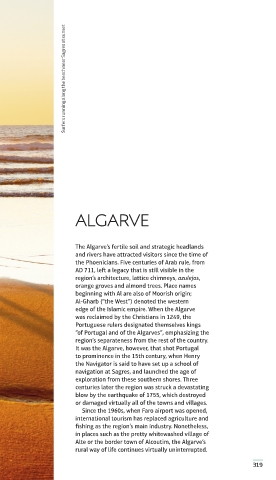
Surfers running along the beach near Sagres at sunset


                    ALGARVE


                    The Algarve’s fertile soil and strategic headlands
                    and rivers have attracted visitors since the time of
                    the Phoenicians. Five centuries of Arab rule, from
                    AD 711, left a legacy that is still visible in the
                    region’s architecture, lattice chimneys, azulejos,
                    orange groves and almond trees. Place names
                    beginning with Al are also of Moorish origin;
                    Al-Gharb (“the West”) denoted the western
                    edge of the Islamic empire. When the Algarve
                    was reclaimed by the Christians in 1249, the
                    Portuguese rulers designated themselves kings
                    “of Portugal and of the Algarves”, emphasizing the
                    region’s separateness from the rest of the country.
                    It was the Algarve, however, that shot Portugal
                    to prominence in the 15th century, when Henry
                    the Navigator is said to have set up a school of
                    navigation at Sagres, and launched the age of
                    exploration from these southern shores. Three
                    centuries later the region was struck a devastating
                    blow by the earthquake of 1755, which destroyed
                    or damaged virtually all of the towns and villages.
                      Since the 1960s, when Faro airport was opened,
                    international tourism has replaced agriculture and
                    fishing as the region’s main industry. Nonetheless,
                    in places such as the pretty whitewashed village of
                    Alte or the border town of Alcoutim, the Algarve’s
                    rural way of life continues virtually uninterrupted.
                                                                  319


   318-319_EW_Portugal.indd   319                            20/09/2018   10:42

