


Page 66 - (DK Eyewitness) Travel Guide - Portugal
P. 66
EXPERIENCE MORE
crafts. Temporary exhibitions,
2 "' lectures and concerts are also
Museu de Artes held in the museum.
Decorativas
EXPERIENCE Alfama do Sol 2 @ 737 v 12, 28 3 "
X3 ⌂ Largo Portas
# 10am–5pm Wed–Mon
São Vicente de Fora
¢ 1 Jan, 1 May, 25 Dec
∑ fress.pt
Y2 ⌂ Largo de São
Vicente § 218 885 652
Also known as the Ricardo
@ 712, 734 v 28 # 9am–
do Espírito Santo Silva
Foundation, the museum was
museum: 10am–5pm Tue–
set up in 1953 to preserve the 5pm Tue–Sat, 9–11am Sun;
Sun ¢ Public hols
traditions and increase public
awareness of the Portuguese St Vincent was proclaimed
decorative arts. The foundation Lisbon’s patron saint in 1173,
was named after a banker when his relics were trans-
who bought the 17th-century ferred from the Algarve to a
Palácio Azurara in 1947 to church on this site outside
house his fine collection of (fora) the city walls. Designed Intricate marble
furniture, textiles, silver and by Italian architect Filippo inlays adorning São
cera mics. Among the 17th- Terzi, and completed in 1627, Vicente de Fora
and 18th-century antiques the sober, off-white façade is
displayed in this hand some in Italian Renaissance style,
four-storey mansion are many with towers either side and inaccurate, tile scenes of
fine pieces in exotic woods, three arches leading to the Afonso Henriques attacking
including an 18th-century entrance hall. Statues of Lisbon and Santarém. Deeper
rose wood back gammon and saints Augustine, Sebastian into the monastery, floral
chess table. Also of note are and Vincent can be seen over designs and cherubs illustrate
the collec tions of 18th-century the entrance. The adjoining the fables of La Fontaine.
silver and Chinese porcelain, former Augustinian monastery, A passageway leads behind
and hand-embroidered wool reached via the nave, retains the church to the old refec-
carpets from Arraiolos. The its 16th-century cistern and tory, transformed into the
spacious rooms still retain vestiges of the former cloister, Bragança Pantheon in 1885.
some original ceilings and but it is visited mainly for its The stone sarcophagi of
azulejo panels. 18th-century azulejos. Among almost every king and queen
In the adjoining building the panels in the en trance hall are here, from João IV, who
are workshops where artisans off the first cloister there are died in 1656, to Manuel II, last
pre serve the techniques of lively, though histori cally king of Portugal. Only Maria I
cabinet-making, gilding, and Pedro IV are not buried
book-binding, wood-carving here. A stone mourner kneels
and other traditional at the tomb of Carlos I and his
son Luís Felipe, assassinated
in Praça do Comércio in 1908.
The church now operates as a
museum, with access to the
Bragança Pantheon.
4 =
Feira da Ladra
Y2 ⌂ Campo de Santa
Clara @ 712 v 28
# 9am–5pm Tue & Sat
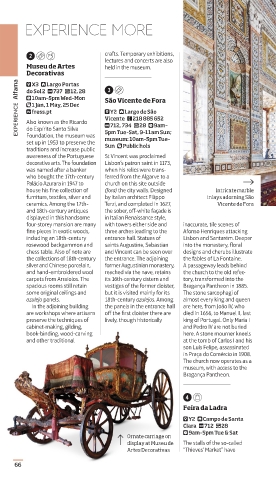
Ornate carriage on
display at Museu de The stalls of the so-called
Artes Decorativas “Thieves’ Market” have
66
066-067_EW_Portugal.indd 66 20/09/2018 17:00
EW Catalogue template v3.0 – 12th July 2018
Fonts: Aptifer Sans LT Pro, Posterama Text, Soho Gothic
Pro, Soho Pro, ITC Caslon 224

