


Page 24 - All About History - Issue 08-14
P. 24
Crime


         Day in the life


        ALCATRAZ PRISON GUARD


         KEEPING AN EYE ON AMERICA’S MOST

         DANGEROUS PRISONERS, ALCATRAZ
         ISLAND, SAN FRANCISCO BAY, 1933-63


             Working in a prison can be a tense job at the best of times, but when the
             prison is on Alcatraz Island, purportedly the most secure penitentiary in
             the world and home to the notorious likes of Al Capone, Alvin Karpis and
             George ‘Machine Gun’ Kelly, this description becomes even more apt.
               Yet life as a prison guard on Alcatraz was much like in any other
             prison, with rigid routines to adhere to and stringent checks to be
             made on all aspects of prison life. There was roughly one guard
             for every three prisoners on Alcatraz – much higher than most
             other prisons, where the ratio was about 1:12. With USA’s
             most dangerous criminals in close proximity, the
             employees always had to be on their guard.

                START OF THE DAY

                If assigned to an early shift, the officer would wake
                up at around 6am in their home they shared with
                their family. With Alcatraz being so remote and
                inaccessible, prison officers lived on the island itself,
                often taking their families with them. Any food and
                grocery shopping had to be purchased during trips
                to the mainland. The only facility on the island
                itself was a small convenience store and post office.

                ROLL CALL

                The roll call took place between the front of the
                main prison building and the lighthouse. The
                primary purpose was to check whether the roster
                of officers was sufficient to carry out the tasks
                waiting for them in the day ahead, and as such
                was relatively informal. Unlike other prisons, no
                time was dedicated to the inspection of the prison
                officers’ attire.

                START OF SHIFT

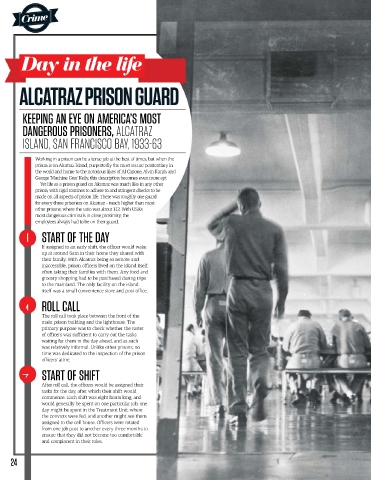
                After roll call, the officers would be assigned their
                tasks for the day, after which their shift would
                commence. Each shift was eight hours long, and
                would generally be spent on one particular job; one
                day might be spent in the Treatment Unit, where
                the convicts were fed, and another might see them
                assigned to the cell house. Officers were rotated
                from one job post to another every three months to
                ensure that they did not become too comfortable
                and complacent in their roles.


     24

