


Page 20 - All About History - Issue 08-14
P. 20
Crime


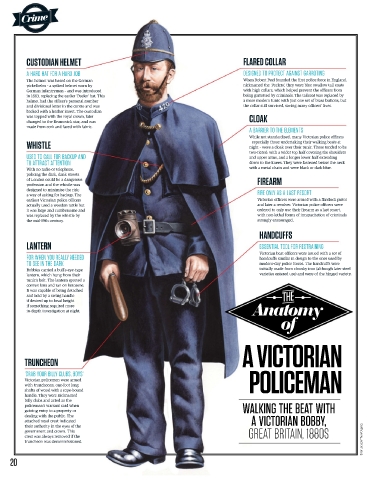
          CUSTODIAN HELMET                                                             FLARED COLLAR

          A HARD HAT FOR A HARD JOB                                                    DESIGNED TO PROTECT AGAINST GARROTING
          The helmet was based on the German                                           When Robert Peel founded the first police force in England,
          pickelhelm – a spiked helmet worn by                                         nicknamed the ‘Peelers’, they wore blue swallow tail coats
          German infantrymen – and was introduced                                      with high collars, which helped prevent the officers from
          in 1863, replacing the earlier ‘Peeler’ hat. This                            being garrotted by criminals. The tailcoat was replaced by
          helmet had the officer’s personal number                                     a more modern tunic with just one set of brass buttons, but
          and divisional letter in the centre and was                                  the collar still survived, saving many officers’ lives.
          backed with a leather insert. The custodian
          was topped with the royal crown, later                                         CLOAK
          changed to the Brunswick star, and was
          made from cork and faced with fabric.
                                                                                         A BARRIER TO THE ELEMENTS
                                                                                         While not standardised, many Victorian police officers
          WHISTLE                                                                        – especially those undertaking their walking beats at
                                                                                         night – wore a cloak over their tunic. These tended to be
                                                                                         two-tiered; with a wider top half covering the shoulders
          USED TO CALL FOR BACKUP AND                                                    and upper arms, and a longer lower half extending
          TO ATTRACT ATTENTION                                                           down to the knees. They were fastened below the neck
                                                                                         with a metal chain and were black or dark blue.
          With no radio or telephone,
          policing the dark, dank streets
          of London could be a dangerous                                                   FIREARM
          profession and the whistle was
          designed to minimise the risk;
                                                                                           with non-lethal forms of incapacitation of criminals
          a way of asking for backup. The                                                  FIRE ONLY AS A LAST RESORT
          earliest Victorian police officers                                               Victorian officers were armed with a flintlock pistol
          actually used a wooden rattle but                                                and later a revolver. Victorian police officers were
          it was large and cumbersome and                                                  ordered to only use their firearm as a last resort,
          was replaced by the whistle by
          the mid-19th century.                                                            strongly encouraged.


          LANTERN                                                                           HANDCUFFS
                                                                                            ESSENTIAL TOOL FOR RESTRAINING
                                                                                            Victorian beat officers were issued with a set of
          FOR WHEN YOU REALLY NEEDED                                                        handcuffs similar in design to the ones used by
          TO SEE IN THE DARK                                                                modern-day police forces. The handcuffs were
          Bobbies carried a bull’s-eye-type                                                 initially made from chunky iron (although later steel
          lantern, which hung from their                                                    varieties entered use) and were of the hinged variety.
          tunic’s belt. The lantern sported a
          convex lens and ran on kerosene.
          It was capable of being detached
          and held by a swing handle                                                                THE
          if desired up to head height
          if something required more
          in-depth investigation at night.                                                Anatomy
                                                                                                    of


                                                                                      A VICTORIAN

          TRUNCHEON
          ‘GRAB YOUR BILLY CLUBS, BOYS’
          Victorian policemen were armed                                                 POLICEMAN
          with truncheons, one-foot long
          shafts of wood with a rope-bound
          handle. They were nicknamed
          billy clubs and acted as the
          policeman’s warrant card when
          gaining entry to a property or                                              WALKING THE BEAT WITH
          dealing with the public. The
          attached royal crest indicated                                                 A VICTORIAN BOBBY,
          their authority in the eyes of the
          government and crown. This                                                    GREAT BRITAIN, 1880S
          crest was always removed if the
          truncheon was decommissioned.                                                                                         ©  Ian Jackson/The Art Agency


     20

