


Page 43 - All About History - Issue 08-14
P. 43
Tour   Guide

                                                               08 Enemy at the gates                             THE KREMLIN
                                                               Throughout the Red Square’s history
                                                                no single event is more significant
                                                                than the November 1941 parade,
                                                                when the German army sat just 40
                                                                miles outside Moscow. In an act of   Moscow, Russia
                                                                defiance, as well as to present a strong
                                                               front, the Red Army held its annual   As old as Moscow itself, the Kremlin was
                                                               parade to commemorate the Bolshevik   originally a fortified settlement thought to be
                                                              Revolution. This time, however, the   from where the city first sprung up. Its walls,
                                                             soldiers continued marching to the front   now made of stone rather than wood, still
                                                            line, which by this stage had reached the   completely encircle the complex. Moscow
                                                          outskirts of the city.               has faced near destruction many times in its
                                                                                               history, but still served as the political centre
                                                                                               of Russia on numerous occasions and to this
                                                                  07 The broken bell           day. Though in competition with St Petersburg,
                                                                        Weighing over 200 tons,   the former Imperial capital, the city still held
                                                                          the Tsar Bell has    the seat of Russian Tsars and emperors, as
                                                                            never been rung    well as the Communist puppet masters of
                                                                             and a large       the Soviet Union. Political giants from across
                                                                              piece of it      the ages, including Peter the Great, Napoleon
                                                                              actually broke   Bonaparte and Josef Stalin, have all made the
                         End here            08                                off during its   walk through the gilded halls of the Kremlin’s
                                                                               casting back
                                                                               in  1737.       palaces and, in modern times, it saw the first
                                                                                               warm words between the East and the West
                                                                                               after decades of the Cold War.

                                                                                  06 CANNON FIT FOR A TSAR
                                                                                          A
                                                                                                     in 1586, it’s unclear
                                                                                                Built for Tsar Feodor


                                                                                                                     not
                                                                                                                  or
                                                                                                       whether
                                                                                                         the Tsar Cannon
                                                                                                          was intended
                                                                                                          for use in
                                                                                                          battle, but it
                                                                                                          remains the
        05
                                                                                                         largest cannon
            06                                                                                         in the world.


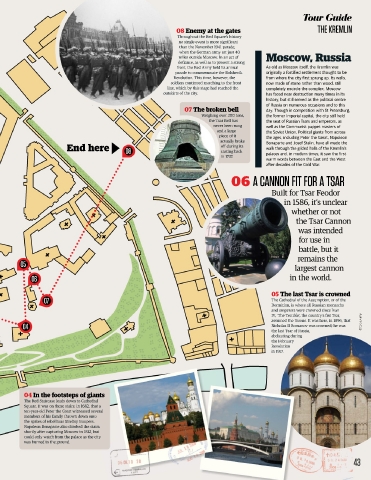
                                                                                                05 The last Tsar is crowned
                07                                                                              The Cathedral of the Assumption, or of the
                                                                                                Dormition, is where all Russian monarchs
                                                                                                and emperors were crowned since Ivan
                                                                                                IV, ‘The Terrible’, the country’s fist Tsar,
                                                                                                assumed the throne. It was here, in 1896, that   © Corbis; Alamy
         04                                                                                     Nicholas II Romanov was crowned; he was
                                                                                                the last Tsar of Russia,
                                                                                                abdicating during
                                                                                                the February
                                                                                                Revolution
                                                                                                in  1917.


          04 In the footsteps of giants
          The Red Staircase leads down to Cathedral
          Square. It was on these stairs, in 1682, that a
          ten-year-old Peter the Great witnessed several
          members of his family thrown down onto
          the spikes of rebellious Streltsy troopers.
          Napoleon Bonaparte also climbed the stairs
          shortly after capturing Moscow in 1812, but
          could only watch from the palace as the city
          was burned to the ground.


                                                                                                                             43 43

