


Page 46 - All About History - Issue 08-14
P. 46
if only temporarily. She was tremendously clever,   Although both parents had been desperate for a
        with an almost unfailing sense of what her   boy, Anne would be a doting mother to her infant
        people wanted or needed from her, but had to   child, but she was sent to the executioner’s block
        see off foreign invasion attempts and homegrown   in 1536 after failing to produce a male heir for her
        rebellions. While she was sitting on the throne   king. Although Henry’s third wife Jane Seymour
        of England the country became acquainted with   was kind to Elizabeth and Mary, she had her own
        some of its greatest triumphs and darkest hours.   child to attend to with the birth of her son and
          When Elizabeth came to the throne in   Henry’s heir, Edward. Henry himself would not
        November 1558, the whole of Europe was on   see much of Elizabeth until 1542, when he decided
        tenterhooks. How would the new Protestant queen   the time had come to reacquaint himself with his
        follow the reign of her Catholic sister Mary? With   young daughter. He found her to be intelligent and
        an unstable nation and conspiracies at home   charming, and decided that he would reinstate
        and abroad, the situation required diplomacy,   both Mary and Elizabeth back into his lineage.
        intelligence and bravery; three qualities of which   In 1543, Henry married Catherine Parr, his
        Elizabeth had always had in ample supply. In   last wife, and relations within the royal family
        fact, the unstable situation was nothing new to   warmed, as Mary took a maternal interest in
        her; Elizabeth’s position had been precarious   young Edward, while Elizabeth enjoyed a sisterly
        from the moment she was born. The daughter   relationship with both. However, when Edward
        of Henry VIII’s second wife, Anne Boleyn, she   took the throne upon their father’s death, cracks
        was immediately deemed as illegitimate by any   started to form. First, Elizabeth had to contend
        Catholic nations, who regarded the king’s divorce   with the amorous attentions of Catherine’s new
        of Catherine of Aragon as illegal. In their eyes,   husband Thomas Seymour, which caused a
        Catherine’s daughter Mary was the only rightful   scandal at court in 1548. Seymour’s intentions

        heir to the throne.                    were seen as treasonous, and Elizabeth was


           While the popular image is that Mary left England in   Borrowing
           a sorry state, Leanda de Lisle explains that Elizabeth’s
           fiscal behaviour was far from immaculate. Mary left   money  in  the
           England £227,000 in debt, while her sister produced
           debts of £350,000. “Mary’s reign was not a ‘disaster’.   16th  century
           The popular image of Mary – always 'Bloody Mary',   Before the English merchant Thomas
           rarely Mary I – has been greatly influenced by a   Gresham came to prominence, the
           combination of sexual and religious prejudice,” explains   Tudors had borrowed money from
           De Lisle: “Mary I had named Elizabeth as her heir,   the great European banks such as the
           despite her personal feelings towards her sister, and so   Antwerp Exchange. However, these
           allowed the crown to be inherited peacefully. Elizabeth   banks charged a high interest rate and it
           continued to refuse to name anyone. In 1562, believing   was generally acknowledged that going
           she was dying, she asked for Robert Dudley to be   around Europe borrowing money did
           made Lord Protector with an income of £20,000.”   nothing to improve England’s image as
           Elizabeth was notoriously reluctant to engage in   a serious power. Money could also be
           warfare because of its costs and risk, but the Spanish   borrowed from independent merchants,
           conflict dragged on for years, while she awarded   such as Horatio Palavicino, who
           monopolies to her favourites at court and crops failed.   Elizabeth was forced to borrow money
           “While we remember Elizabeth’s success in repelling   from late in her reign. Gresham had
           the Armada in 1588," says De Lisle, "We forget that the   previously helped Edward VI rid himself
           war continued and impoverished the country and the   of most of his debts and founded the
           crown, a situation made worse by the corruption of   Royal Exchange in 1571 to challenge the
           court officials including notorious high-ranking figures   power of Antwerp.
           such as Robert Cecil. People starved in the 1590s and   Now that Elizabeth could seek loans
           the elite even began to fear possible revolution.”  from within her realm, she was able to
                                                 exert greater pressure to get what she
           Verdict                               wanted, while Parliament could grant
           Elizabeth was forced to deal with circumstances   her more funds if they wanted. Later in
           beyond her control, such as poor harvests and an   her reign, she began to use increasingly
           ongoing conflict with Spain, but the fact is that she was   severe taxation, which contributed to
           not the financial marvel many believe her to be.  her decreasing popularity.
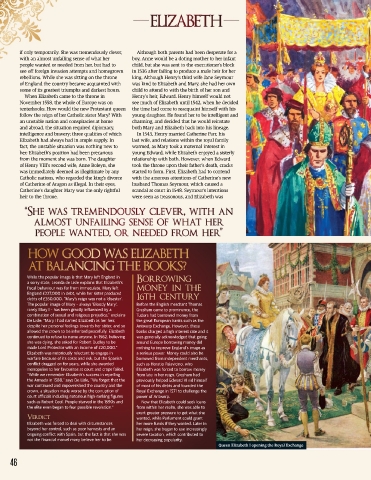
                                                                              Queen Elizabeth I opening the Royal Exchange
     46

