


Page 67 - All About History - Issue 08-14
P. 67
Wrath of the Khans


        changing horses at each one to keep each end of
        this vast realm in constant communication. His
        empire was administered by a multinational cast   Marco Polo among the Mongols
        of functionaries, whose origins he had divided
        into four categories of trustworthiness: first, the   Though Marco Polo was by no means the first European   golden tablet of free passage and a request to bring back
        Mongols; second, other Central Asian people; third,   traveller to visit China or the court of Kublai Khan – and   100 men to teach Christianity and European customs to
        Manchurians and Koreans; and then last, the   some modern historians dispute whether his adventures   the voracious early adaptors of his multinational court,
        Chinese. Meanwhile, ambassadors and travellers   even took place and were instead cobbled together from   they were the real pioneers and Marco Polo the wide-
        from further afield were welcome with open arms   the accounts of Arab and Persian traders on the Mongol   eyed passenger.
        for the knowledge and wealth they could bring –   Empire’s south-western fringe – his account was the most   Nonetheless, the Great Khan seemed particularly
        Christian missionaries even built churches.  well known and most widely read for centuries.  taken with Marco – who even before the publication of
                                                  Setting off from the powerful Italian city state of    his sensational proto-Lonely Planet guide in Old French,
          While Genghis Khan’s capital was Karakorum,   Venice with his father and uncle in 1271, the Polo trio   Livres des merveilles du monde (‘Descriptions Of The
        deep in his Mongolian heartland, Kublai desired a   crossed the Black Sea and journeyed through Central Asia   World’ in English), could tell a tale – and refused the
        capital worthy of an emperor in the domain where   via the Silk Road with a Papal diplomatic mission for the   Polo men permission to leave. Instead, Kublai Khan set
        he had spent his youth. He installed his court   court of Kublai Khan.           them up as his roving emissaries, travelling the length
        in a newly built ‘winter capital’ – as traditionally   Though it’s the 17-year-old Marco who dominates the   and breadth of his domain and even further afield to
                                                  narrative and looms large in popular imagination, for   Southern India as the Khan’s ambassadors, and reporting
        nomadic people, the entire Mongol court would   father Niccolò and uncle Maffeo Polo this was in fact   back, making their incredible 24-year adventure around
        travel with the seasons, chasing the light to warmer
                                                  a return journey to the Emperor’s court at Khanbaliq.   the Far East as much a silk-coated prison sentence as it
        climes – in what is now Beijing. Known as Dadu in   Having first visited Kublai in 1260 and been gifted a   was a working holiday. If it happened at all, that is...
        Chinese (meaning ‘grand capital’), in Mongolian it
        was called Khanbaliq – the City of the Khan, and
        its iconic Drum Tower still stands in the heart of
        modern China’s bustling capital.
          ”The streets are so straight and wide that you
        can see right along them from end to end and from
        one gate to the other. And up and down the city
        there are beautiful places, and many great and fine
        hostelries, and fine houses in great numbers,” wrote
        Kublai Khan’s most famous foreign visitor, the
        Italian traveller and merchant Marco Polo.
          At the centre of Khanbaliq was the Khan’s palace,
        painted red and white, where, under the watchful
        eye of a thousand guards, he kept his four wives
        in opulent luxury. In summer, the court would
        decamp and return to Mongolia to the walled tent
        city of Shangdu – known evocatively as Xanadu.
        Polo described two vast palaces, one made of
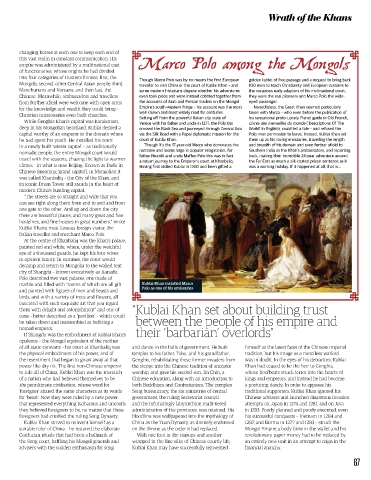
        marble and filled with “rooms of which are all gilt   Kublai Khan installed Marco
                                                   Polo as one of his emissaries
        and painted with figures of men and beasts and
        birds, and with a variety of trees and flowers, all
        executed with such exquisite art that you regard
        them with delight and astonishment” and one of   “ Kublai Khan set about building trust
        cane – better described as a ‘pavilion’ – which could
        be taken down and reassembled as befitting a   between the people of his empire and
        nomad emperor.
          If Shangdu was the embodiment of Kublai Khan’s  their ‘barbarian’ overlords”
        opulence – the Mongol equivalent of the mother
        of all static caravans – his court at Khanbaliq was   and dance in the halls of government. He built   himself as the latest facet of the Chinese imperial
        the physical embodiment of his power, and of   temples to his father, Tolui, and his grandfather,   tradition, but his image as a merciless warlord
        the resentment that began to gnaw away at that   Genghis, rehabilitating these former invaders from   was in doubt. In the eyes of his detractors, Kublai
        power like dry rot. The first non-Chinese emperor   the steppe into the Chinese tradition of ancestor   Khan had ceased to be the heir to Genghis,
        to rule all of China, Kublai Khan was the monarch   worship, and gave his second son, Jin Chin, a   whose hoofbeats struck terror into the hearts of
        of a nation who had believed themselves to be   Chinese education, along with an introduction to   kings and emperors, and instead he had become
        the penultimate civilisation, whose word for   both Buddhism and Confucianism. The complex   a posturing dandy. In order to appease his
        ‘foreigner’ shared the same characters as its words   Song bureaucracy, the six ministries of central   traditional supporters, Kublai Khan ignored his
        for ‘beast’. Now they were ruled by a new power   government, the ruling Secretariat council   Chinese advisers and launched disastrous invasion
        that represented everything barbarous and uncouth   and the infuriatingly labyrinthine multi-tiered   attempts on Japan in 1274 and 1281, and on Java
        they believed foreigners to be, no matter that these   administration of the provinces, was retained. His   in 1293. Poorly planned and poorly executed, even
        foreigners had crushed the ruling Song Dynasty.   bloodline was wallpapered into the mythology of   his successful conquests – Vietnam in 1284 and
          Kublai Khan strived to reinvent himself as a   China as the Yuan Dynasty, as divinely enshrined   1287, and Burma in 1277 and 1283 – struck the
        suitable ruler of China – he restored the elaborate   on the throne as the order it had replaced.  Mongol Empire a body blow in the wallet and his
        Confucian rituals that had been a hallmark of   With one foot in the stirrups and another   revolutionary paper money had to be replaced by
        the Song court, baffling his Mongol generals and   wrapped in the fine silks of Chinese courtly life,   an entirely new unit in an attempt to reign in the
        advisers with the sudden enthusiasm for song   Kublai Khan may have successfully reinvented   financial anarchy.
                                                                                                                             67

