


Page 79 - All About History - Issue 08-14
P. 79
History's narrowest escapes


                                                                                       off and at 9pm the El Estero slowly sank into the
                                                                                       water, belching smoke, but not exploding, as the
                                                                                       seawater poured in and cooled the ship down.
                                                                                         Disaster had been averted in the nick of time,
                                                                                       and amazingly not a single life was lost. It was the
                                                                                       biggest single threat New York faced during the
                                                                                       whole of the war. Had the El Estero exploded it
                                                                                       could have cost thousands of lives in the area and
            uring WWII the citizens of the United States   to the craft, hauling the El Estero away from the   left much of Lower Manhattan, Brooklyn, Staten
            were spared the aerial onslaught suffered   dockside and the main shipping channel as fast as   Island and the New Jersey ports of Jersey City and
            by European civilians but the city of New   their creaking and straining engines would allow   Bayonne in ruins. The destruction would also have
            York only narrowly avoided devastation   them to.                          severely dented the US war effort. The next day,
       Dduring the height of the conflict. This   As the ship’s seacocks were inaccessible, she   New York mayor Fiorello la Guardia went on local
        devastation wouldn’t have occurred due to a   would have to be sunk by pumping water into   radio saying: “We felt that at any minute we might
        scheme engineered by the Nazis or the Japanese,   her cargo holds. Sailing alongside the vessel, the   be gone and thank God we got through it safely.”
        but would have been brought about by one of their   firefighting boats pumped thousands of gallons of
        own boats, the SS El Estero. Without the actions   water onto the ship in a desperate battle against
        of a few brave souls, the ship’s name would have   the clock. Lieutenant Commander John Stanley
        gone down in infamy.                   was in charge of the operation and asked for
          The drama unfolded on 24 April 1943, as vessels   twenty Coast Guard volunteers to remain aboard
        bound for the European theatre were loaded with   in an attempt to assuage the fires. Those who
        ordnance in Bayonne. They included the El Estero,   stayed knew their odds of survival weren’t good.
        an antiquated 99-metre (325-foot) Panamanian   Inside, the fire was still raging and the heat on

        freighter, which was loading huge 1,800-kilogram   deck was so intense it was singeing the shoes
        (4,000-pund) blockbuster bombs at Craven Point   of those firefighters still aboard. However, the
        pier. It was carrying 1,365 tons of deadly cargo.  fireboats and the Coast Guard volunteers appeared
          It was the day before Easter Sunday and those   to be doing enough to stop the bombs detonating.
        loading the ship were no doubt looking forward to   Eventually, the ship reached the target area near
        a well-earned rest when suddenly, at the nearby   the Robbins Reef lighthouse. As water washed
        Coast Guard barracks a shout went up: “Ammo   over the deck, the remaining hands were ordered
        ship on fire!” A blaze had broken out on the El
        Estero after a boiler flashback had ignited oil
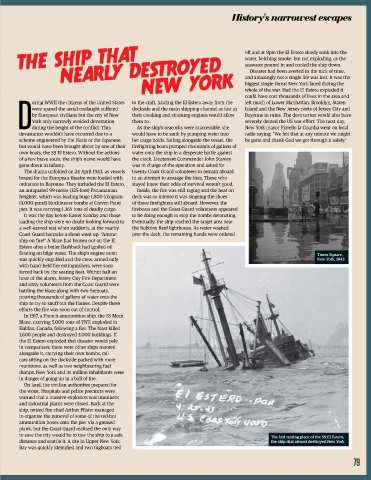
        floating on bilge water. The ship’s engine room                                                         Times Square,
        was quickly engulfed and the crew, armed only                                                           New York, 1943
        with hand–held fire extinguishers, were soon
        forced back by the searing heat. Within half an
        hour of the alarm, Jersey City Fire Department
        and sixty volunteers from the Coast Guard were
        battling the blaze along with two fireboats,
        pouring thousands of gallons of water onto the
        ship to try to snuff out the flames. Despite these
        efforts the fire was soon out of control.
          In 1917, a French ammunition ship, the SS Mont
        Blanc, carrying 5,000 tons of TNT, exploded in
        Halifax, Canada, following a fire. The blast killed
        1,600 people and destroyed 3,000 buildings. If
        the El Estero exploded that disaster would pale
        in comparison; there were other ships moored
        alongside it, carrying their own bombs, rail
        cars sitting on the dockside packed with more
        munitions, as well as two neighbouring fuel
        dumps. New York and its million inhabitants were
        in danger of going up in a ball of fire.
          On land, the civilian authorities prepared for
        the worst. Hospitals and police precincts were
        warned that a massive explosion was imminent
        and industrial plants were closed. Back at the
        ship, retired fire chief Arthur Pfister managed
        to organise the removal of some of the red-hot
        ammunition boxes onto the pier via a greased
        plank, but the Coast Guard realised the only way
        to save the city would be to tow the ship to a safe                                     The last resting place of the SS El Estero,
        distance and scuttle it. A site in Upper New York                                       the ship that almost destroyed New York
        Bay was quickly identified and two tugboats tied
                                                                                                                             79

