


Page 83 - All About History - Issue 08-14
P. 83
History's narrowest escapes


               t the Battle of Trafalgar in 1805, Admiral   July 1797, he led a group of British boats in a night
               Lord Nelson’s fleet defeated the French   raid. Nelson’s barge was involved in hand-to-hand
               and Spanish navy. It was a stunning   combat with the crew of a Spanish boat and
               victory in which the British didn’t   Nelson led from the front. Seeing his superior in
          Alose a single ship. Although Nelson   danger, Nelson’s coxswain, John Sykes, put himself
          himself was killed during the action, the battle   in the way of potentially fatal blows. Nelson later
          cemented his legend.                 recalled: “This was a service hand-to-hand with
            Yet Nelson wouldn’t have been there but for   swords, in which my coxswain John Sykes twice
          the bravery of a humble sailor several years   saved my life.”
          earlier. By 1797, Nelson was a battle-hardened   Sykes’s heroics did not go unnoticed, with
          officer who had lost the sight in his right eye.   Nelson touting him for promotion but he was
          Britain had been at war with France since   killed in action a year later. Nelson made his
          1793 and Rear Admiral Nelson tasked with   mark on history but Britain came perilously
          blockading the Spanish fleet at Cadiz. On 3   close to their hero not even being there.
         “ Napoleon knew he would need
          command of the English Channel”                                                     The Battle of Trafalgar was

                                                                                              Lord Nelson’s finest victory


             apoleon Bonaparte never did hide his   with the still-trapped fleet from Brest as planned,   Napoleon’s invasion force.
             ambition to conquer Britain. In 1797, he   Villeneuve captured some British ships and was   Napoleon wrote to Villeneuve urging: “Get to
             said the French, “Must destroy the English   soon heading back towards the English Channel.   sea, lose no time… England is ours!” But Villeneuve
             monarchy, or expect itself to be destroyed   By 22 July, Villeneuve’s force was off Cape   ignored him took his fleet to Cadiz. Hearing the
       Nby these intriguing and enterprising   Finisterre, on the northwestern tip of Spain,   news, Napoleon declared: “What a navy… what an
        islanders… let us concentrate all our efforts on the   when they ran into a British force. There was   admiral. What sacrifices for nothing!”
        navy and annihilate England. That done, Europe is   an indecisive clash in the fog and Villeneuve   Once he arrived in Cadiz, Villeneuve was again
        at our feet.”                          was able to retire to the nearby port of Ferrol.   blockaded and Napoleon’s chance to deceive the
          The same year the French had attempted to   There was still time for Villeneuve, now with   British navy had passed. The two powers clashed
        land an invading army in Wales but it had been   a fleet of 29 ships, to break through the British   in a battle called Trafalgar in which the Franco-
        foiled, partly thanks to bad weather. But Napoleon,   force blockading Brest in Brittany, link up with   Spanish fleet lost twenty-two ships and the British
        who seized power in France in 1799, showed no   the French ships trapped inside the port and   none. Nelson was mortally wounded, Villeneuve
        signs of giving up and in 1803, created an invasion   bear down on the Channel and rendezvous with   captured and a nation had been narrowly saved.
        army. It consisted of a hundred and fifty thousand
        men assembled at camps in northern France and
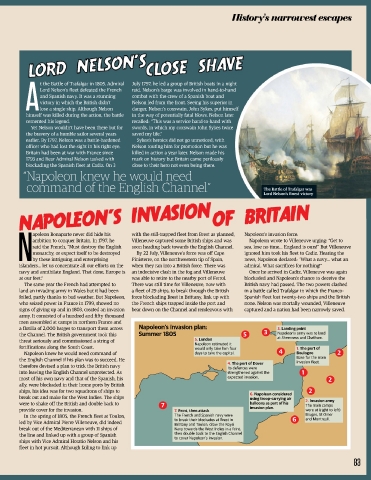
        a flotilla of 2,000 barges to transport them across   Napoleon’s invasion plan:            3. Landing point
        the Channel. The British government took this   Summer 1805                    5      3    Napoleon’s army was to land
                                                                                                   at Sheerness and Chatham.
        threat seriously and commissioned a string of                5. London
                                                                     Napoleon estimated it
        fortifications along the South Coast.                        would only take him four            1. The port of
          Napoleon knew he would need command of                     days to take the capital.     4     Boulogne       2
                                                                                                         Base for the main
        the English Channel if his plan was to succeed. He                                               invasion fleet.
        therefore devised a plan to trick the British navy                       4. The port of Dover
                                                                                 Its defences were
        into leaving the English Channel unprotected. As                         strengthened against the   1
        most of his own navy and that of the Spanish, his                        expected invasion.                 2
        ally, were blockaded in their home ports by British
        ships, his idea was for two squadrons of ships to                                                     2
                                                                                         6. Napoleon considered
        break out and make for the West Indies. The ships                                using troop-carrying air   2. Invasion army
        were to shake off the British and double back to   7                             balloons as part of his   The main camps
        provide cover for the invasion.                       7. Feint, then attack      invasion plan.     were at (right to left)
          In the spring of 1805, the French fleet at Toulon,   The French and Spanish navy were             Bruges, St Omer
                                                              to break their blockades at Brest in      6   and Montreull.
        led by Vice Admiral Pierre Villeneuve, did indeed     Brittany and Toulon, draw the Royal
        break out of the Mediterranean with 11 ships of       Navy towards the West Indies in a feint,
        the line and linked up with a group of Spanish        then double back to the English Channel
                                                              to cover Napoleon’s invasion.
        ships with Vice Admiral Horatio Nelson and his
        fleet in hot pursuit. Although failing to link up
                                                                                                                             83

