


Page 84 - All About History - Issue 08-14
P. 84
History's narrowest escapes


             n a clear, sunny morning on 6 August 1945,   thanks to the effects of radiation, and 69 per cent   Yamaguchi’s office, hurling him to the ground.
             Tsutomu Yamaguchi was making his way   of the city’s buildings were flattened. Yet Japan   Again he was only about three kilometres
             along a track through some potato fields   did not surrender. For the young engineer it might   (two miles) from the epicentre and although his
             when he heard the faint noise of an aircraft   have been the end of the story – except that his   bandages were torn off, he was otherwise unhurt,
       O in the sky above. A naval draftsman, he   home city was called Nagasaki. After being treated   thanks partly to the protection of a nearby steel
        had just got off a tram and was walking towards   at a hospital there, Yamaguchi reported to his head   stairwell. Yamaguchi got out through a window
        his workplace, a shipyard in the Japanese city of   office for work on 9 August.   and made his way through the ruined streets to
        Hiroshima, where he had been working as part of   At work he was telling his boss what had   his home. It had been destroyed but his family
        a three-month posting. The job was finally coming   happened in Hiroshima when there was another   were safe. Around 70,000 other people weren’t so
        to an end and Yamaguchi was looking forward to   blinding flash. A second atomic weapon, this time   lucky and died in the attack and just a few days
        getting back to his wife and baby son waiting at   a 25-kiloton plutonium bomb dubbed ‘Fat Man’,   later Japan surrendered. Tsutomu Yamaguchi lived
        their home, which was some 420 kilometres (260   had been dropped. The resulting blast shattered   to be 93.
        miles) away.
          At the sound of the plane, the 29-year-old   “ Yamaguchi was suddenly blinded by what
        looked up and saw a tiny object fall out. The plane
        was a US B-29 bomber called Enola Gay. Its crew   he later described as a 'great white flash in
        was tasked with dropping the first atomic weapon
        ever to be used in war and the object Yamaguchi   the sky' accompanied by a deafening roar”
        had seen was a 13-kiloton uranium bomb. 43
        seconds later, at just under 600 metres (2,000feet)
        above the city, it detonated.
          Down below, Yamaguchi was suddenly blinded
        by what he later described as a ‘great white flash in
        the sky’ accompanied by a deafening roar. Trying
        to dive down, as he had been trained to do, he was
        instead sucked up into the air, then violently flung
        down to the ground. A few moments later he came
        to, lying in the mud. At first, as he opened his
        eyes, he could see little. Slowly, as the dust began
        to clear, he could make out the singed leaves of
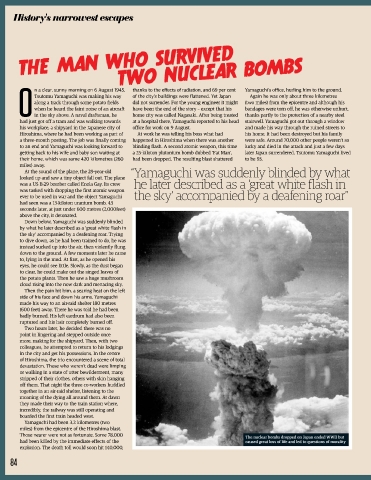
        the potato plants. Then he saw a huge mushroom
        cloud rising into the now dark and menacing sky.
          Then the pain hit him, a searing heat on the left
        side of his face and down his arms. Yamaguchi
        made his way to an air-raid shelter 180 metres
        (600 feet) away. There he was told he had been
        badly burned. His left eardrum had also been
        ruptured and his hair completely burned off.
          Two hours later, he decided there was no
        point in lingering and stepped outside once
        more, making for the shipyard. Then, with two
        colleagues, he attempted to return to his lodgings
        in the city and get his possessions. In the centre
        of Hiroshima, the trio encountered a scene of total
        devastation. Those who weren’t dead were limping
        or walking in a state of utter bewilderment, many
        stripped of their clothes, others with skin hanging
        off them. That night the three co-workers huddled
        together in an air-raid shelter, listening to the
        moaning of the dying all around them. At dawn
        they made their way to the train station where,
        incredibly, the railway was still operating and
        boarded the first train headed west.
          Yamaguchi had been 3.2 kilometres (two
        miles) from the epicentre of the Hiroshima blast.
        Those nearer were not as fortunate. Some 78,000
                                                                                       The nuclear bombs dropped on Japan ended WWII but
        had been killed by the immediate effects of the                                caused great loss of life and led to questions of morality
        explosion. The death toll would soon hit 140,000,
     84

