


Page 164 - Nilam_Publication_module_Chemistry_Form.pdf
P. 164
MODULE • Chemistry Form 4

                 (b)  State another test to identify C.
                     Nyatakan satu lagi ujian bagi mengenali C.
                     Add potassium hexacyanoferrate(II) solution, light blue precipitate formed

                 (c)  What are the possible cations present in solution D?
                     Apakah kation-kation yang mungkin terdapat dalam larutan D?
                     Al , Pb 2+
                       3+
                 (d)  Describe briefly a test that can differentiate the cations present in solution D.
                     Terangkan secara ringkas satu ujian yang boleh digunakan untuk membezakan kation-kation yang hadir dalam larutan D.
                                                                                                    3
                     – Add a few drops of potassium iodide / sodium chloride / sodium sulpahte solution into 1 cm  of solution D.
                     – Yellow/white precipitate formed, lead(II) ion / Pb  present
                                                               2+
                     – No precipitate, aluminium ion / Al  present.
                                                   3+

             4   You are given lead(II) carbonate, zinc(II) carbonate and copper(II) carbonate.
                 Without using any reagents, describe how you can differentiate the three substances in the laboratory.
                 Anda  diberi  plumbum(II)  karbonat,  zink(II)  karbonat  dan  kuprum(II)  karbonat.  Tanpa  menggunakan  sebarang  bahan  uji,  terangkan
                 bagaimana anda membezakan ketiga-tiga bahan tersebut di dalam makmal.
                 •   Heat     strongly     one spatula of each salt in a   boiling tube    and observe the residue:
                     Panaskan dengan       kuat        satu spatula setiap jenis garam dalam   tabung didih   dan perhatikan baki-
                     bakinya:
                     –  If the residue is yellow when hot and white when cold, then   zinc oxide    is formed. The salt is   zinc carbonate  .
                        Jika baki berwarna kuning apabila panas dan putih apabila sejuk, maka   zink oksida   terbentuk. Garam tersebut
                       adalah     zink karbonat  .
                     –  If the residue is black, then   copper(II) oxide    is formed. The salt is   copper(II) carbonate  .
                        Jika baki berwarna hitam, maka   kuprum(II) oksida   terbentuk. Garam tersebut adalah   kuprum(II) karbonat  .
                     –  If the residue is brown when hot and yellow when cold, then   lead(II) oxide   formed. The salt is
                           lead(II) carbonate  .
                        Jika baki berwarna perang apabila panas dan kuning apabila sejuk, maka   plumbum(II) oksida   terbentuk. Garam
                       tersebut adalah   plumbum(II) karbonat  .

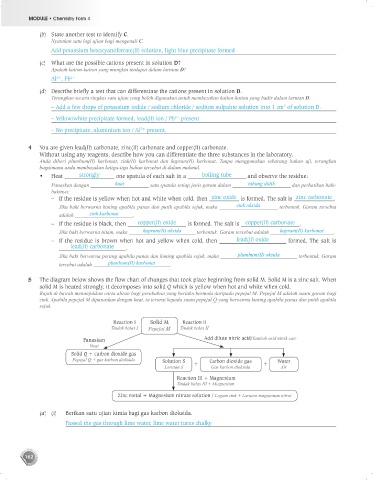
             5   The diagram below shows the flow chart of changes that took place beginning from solid M. Solid M is a zinc salt. When
                 solid M is heated strongly, it decomposes into solid Q which is yellow when hot and white when cold.
                 Rajah di bawah menunjukkan carta aliran bagi perubahan yang berlaku bermula daripada pepejal M. Pepejal M adalah suatu garam bagi
                 zink. Apabila pepejal M dipanaskan dengan kuat, ia terurai kepada suatu pepejal Q yang berwarna kuning apabila panas dan putih apabila
                 sejuk.

                                          Reaction I  Solid M    Reaction II
                                         Tindak balas I  Pepejal M  Tindak balas II

                                Panaskan                                 Add dilute nitric acid/Tambah asid nitrik cair
                                  Heat
                            Solid Q + carbon dioxide gas
                            Pepejal Q + gas karbon dioksida  Solution S  +  Carbon dioxide gas   +  Water
                                                           Larutan S       Gas karbon dioksida     Air
                                                                Reaction III + Magnesium
                                                                Tindak balas III + Magnesium

                                           Zinc metal + Magnesium nitrate solution / Logam zink + Larutan magnesium nitrat

                 (a)  (i)   Berikan satu ujian kimia bagi gas karbon dioksida.
                          Passed the gas through lime water, lime water turns chalky


            162
           Nilam Publication Sdn. Bhd.

        07-Chem F4 (3p).indd   162                                                                                 12/9/2011   5:55:24 PM

