


Page 175 - Nilam_Publication_module_Chemistry_Form.pdf
P. 175
Chemistry Form 4 • MODULE

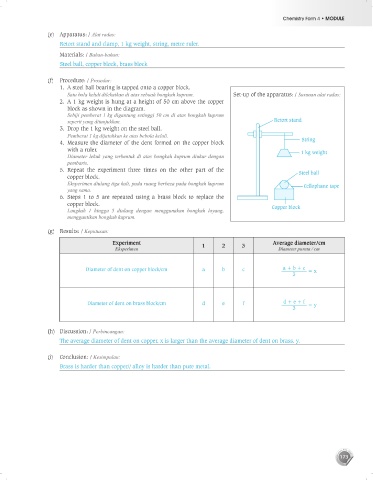
                    (e)  Apparatus: / Alat radas:
                        Retort stand and clamp, 1 kg weight, string, metre ruler.
                        Materials: / Bahan-bahan:
                        Steel ball, copper block, brass block


                    (f)  Procedure: / Prosedur:
                        1.  A steel ball bearing is tapped onto a copper block.
                           Satu bola keluli dilekatkan di atas sebuah bongkah kuprum.  Set-up of the apparatus: / Susunan alat radas:
                        2.  A 1 kg weight is hung at a height of 50 cm above the copper
                          block as shown in the diagram.
                           Sebiji pemberat 1 kg digantung setinggi 50 cm di atas bongkah kuprum
                          seperti yang ditunjukkan.                                              Retort stand
                        3.  Drop the 1 kg weight on the steel ball.
                           Pemberat 1 kg dijatuhkan ke atas bebola keluli.
                        4.  Measure the diameter of the dent formed on the copper block                   String
                          with a ruler.                                                                   1 kg weight
                           Diameter lekuk yang terbentuk di atas bongkah kuprum diukur dengan
                          pembaris.
                        5.  Repeat  the  experiment  three  times  on  the  other  part  of  the         Steel ball
                          copper block.
                           Eksperimen diulang tiga kali, pada ruang berbeza pada bongkah kuprum            Cellophane tape
                          yang sama.
                        6.  Steps  1  to  5  are  repeated  using  a  brass  block  to  replace  the
                          copper block.
                           Langkah  1  hingga  5  diulang  dengan  menggunakan  bongkah  loyang,   Copper block
                          menggantikan bongkah kuprum.

                    (g)  Results: / Keputusan:
                                          Experiment                    1      2      3         Average diameter/cm
                                           Eksperimen                                             Diameter purata / cm


                                 Diameter of dent on copper block/cm    a      b      c             a + b + c   = x
                                                                                                       3


                                 Diameter of dent on brass block/cm     d      e      f             d + e + f   = y
                                                                                                       3


                    (h)  Discussion: / Perbincangan:
                        The average diameter of dent on copper, x is larger than the average diameter of dent on brass, y.


                    (i)  Conclusion: / Kesimpulan:
                        Brass is harder than copper// alloy is harder than pure metal.


                                                                                                                       173
                                                                                                                         Nilam Publication Sdn. Bhd.


        08-Chem F4 (3p).indd   173                                                                                 12/9/2011   5:54:31 PM

