


Page 82 - Nilam_Publication_module_Chemistry_Form.pdf
P. 82
MODULE • Chemistry Form 4

             7   Comparing the Formation of Ionic and Covalent Bonds / Perbandingan Pembentukan Ikatan Ion dan Kovalen

                                           Ionic Bond / Ikatan Ion                  Covalent Bond / Ikatan Kovalen

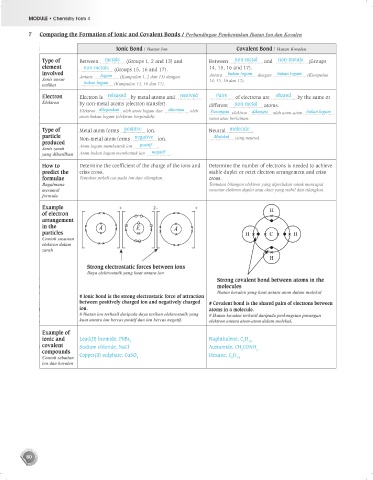
                  Type of     Between   metals   (Groups 1, 2 and 13) and     Between   non-metal   and   non-metals   (Groups
                  element       non-metals   (Groups 15, 16 and 17).       14, 15, 16 and 17).
                  involved            logam                                Antara   bukan logam   dengan   bukan logam   (Kumpulan
                  Jenis unsur   Antara       (Kumpulan 1, 2 dan 13) dengan    14, 15, 16 dan 17).
                  terlibat      bukan logam   (Kumpulan 15, 16 dan 17).
                  Electron    Electron is   released   by metal atoms and   received     Pairs   of electrons are   shared   by the same or
                  Elektron    by non-metal atoms (electron transfer).      different   non-metal   atoms.
                              Elektron   dilepaskan   oleh atom logam dan   diterima   oleh   Pasangan   elektron   dikongsi   oleh atom-atom   bukan logam
                              atom bukan logam (elektron berpindah).       sama atau berlainan.
                  Type of     Metal atom forms   positive   ion.           Neutral   molecule  .
                  particle    Non-metal atom forms   negative   ion.        Molekul   yang neutral.
                  produced                         positif
                  Jenis zarah   Atom logam membentuk ion   .
                  yang dihasilkan  Atom bukan logam membentuk ion   negatif  .
                  How to      Determine the coefficient of the charge of the ions and    Determine the number of electrons is needed to achieve
                  predict the   criss cross.                               stable duplet or octet electron arrangement and criss
                  formulae    Tentukan pekali cas pada ion dan silangkan.  cross.
                  Bagaimana                                                Tentukan bilangan elektron yang diperlukan untuk mencapai
                  meramal                                                  susunan elektron duplet atau oktet yang stabil dan silangkan.
                  formula

                  Example                   +           2–            +
                  of electron
                  arrangement
                  in the             A            E            A
                  particles
                  Contoh susunan
                  elektron dalam
                  zarah

                                 Strong electrostatic forces between ions
                                 Daya elektrostatik yang kuat antara ion
                                                                             Strong covalent bond between atoms in the
                                                                             molecules
                                                                             Ikatan kovalen yang kuat antara atom dalam molekul
                              # Ionic bond is the strong electrostatic force of attraction
                              between positively charged ion and negatively charged   # Covalent bond is the shared pairs of electrons between
                              ion.                                         atoms in a molecule.
                              # Ikatan ion terhasil daripada daya tarikan elektrostatik yang   # Ikatan kovalen terhasil daripada perkongsian pasangan
                              kuat antara ion bercas positif dan ion bercas negatif.  elektron antara atom-atom dalam molekul.
                  Example of
                  ionic and   Lead(II) bromide, PbBr 2                     Naphthalene, C H
                                                                                      8
                                                                                        10
                  covalent    Sodium chloride, NaCl                        Acetamide, CH CONH
                  compounds   Copper(II) sulphate, CuSO                    Hexane, C H   3  2
                  Contoh sebatian                 4                               6  14
                  ion dan kovalen


            80
           Nilam Publication Sdn. Bhd.

        04-Chem F4 (3P).indd   80                                                                                  12/9/2011   5:57:11 PM

