


Page 84 - Nilam_Publication_module_Chemistry_Form.pdf
P. 84
MODULE • Chemistry Form 4


                                      Ionic compound / Sebatian ion             Covalent compound / Sebatian kovalen
              Solubility       –  Most are   soluble   in water and   insoluble   in     –  Insoluble   in water but   soluble   in organic
              Keterlarutan     organic solvent*.                            solvents* (example: ether, alcohol, benzene,
                               Kebanyakannya   larut   dalam air tetapi   tidak larut     tetrachloromethane and propanone). This is because
                               dalam pelarut organik*                       covalent molecules and organic solvents are both
                               –  This is because the polarisation of water molecule.   held together by weak Van der Waals forces.
                               Water molecules have partially positive end (the   Tidak larut   dalam air tetapi   larut   dalam pelarut
                               hydrogen end) and partially negative end (the   organik* (contoh: eter, alkohol, benzena, tetraklorometana
                               oxygen end).                                 dan propanon). Ini kerana molekul kovalen dan pelarut
                               Ini kerana air adalah molekul yang berkutub. Molekul   organik ditarik oleh daya tarikan Van der Waals yang lemah.
                               air mempunyai bahagian bercas separa positif (bahagian   * Organic solvents are covalent compounds that exist
                               hidrogen) dan bahagian bercas separa negatif (bahagian   as liquid at room temperature.
                               oksigen).                                    * Pelarut organik adalah sebatian kovalen yang wujud
                                                                               dalam bentuk cecair pada suhu bilik.


               EXERCISE / LATIHAN

             1   The Table below shows the proton number of elements D, E, F, G, J and L.
                 Jadual di bawah menunjukkan nombor proton bagi unsur D, E, F, G, J dan L.
                  Element / Unsur                  D           E           F           G            J          L
                  Proton number / Nombor proton    1           6           17          11          18          8
                 (a)  Which element in the table are metal and non-metal / Unsur yang manakah merupakan logam dan bukan logam?
                     (i)   Metal / Logam :   G                         (ii)  Non-metals / Bukan logam :   D, E, F, J, L
                 (b)  State an element that exists as monoatomic gas. Explain your answer.
                     Nyatakan unsur yang wujud sebagai gas monoatom. Terangkan jawapan anda.
                     Element J, Atom J has 8 electrons in the outermost shell, the atom has achieved stable octet electron arrangement.
                 (c)  Write the formula for the ion formed from an atom of element L.
                     Tuliskan formula ion yang terbentuk daripada atom unsur L.
                     L 2–
                 (d)  Element E reacts with element L to form a compound / Unsur E bertindak balas dengan unsur L untuk membentuk sebatian.
                     (i)   State the type of bond present in this compound / Nyatakan jenis ikatan yang wujud dalam sebatian ini.
                          Covalent bond
                     (ii)  Write the formula of the compound formed / Tuliskan formula bagi sebatian yang terbentuk.
                          EL
                            2
                     (iii)  Explain how a compound is formed between element E and element L based on their electron arrangement.
                         Jelaskan dari segi susunan elektron bagaimana unsur E dan unsur L bergabung membentuk sebatian.
                          – E atom with electron arrangement 2.4 needs four electrons to achieve stable octet electron arrangement.
                          – L atom with an electron arrangement 2.6 needs two electrons to achieve octet electron arrangement.
                          – One E atom share four pairs of electrons with two L atoms to form a molecule with the formula EL .
                                                                                                              2
                          – One E atom contributes four electrons and each of the two L atoms contributes two electrons for sharing to

                            form double covalent bond.
                          – One E atom forms two double covalent bond with two L atoms.
                          – E atom and L atom achieve stable octet electron arrangement that is 2.8.

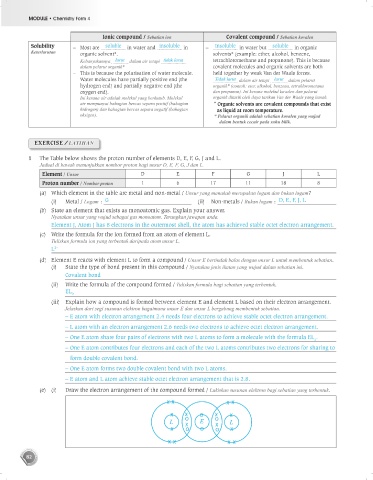
                 (e)  (i)   Draw the electron arrangement of the compound formed / Lukiskan susunan elektron bagi sebatian yang terbentuk.


                                                             L         E          L


            82
           Nilam Publication Sdn. Bhd.

        04-Chem F4 (3P).indd   82                                                                                  12/9/2011   5:57:11 PM

