


Page 45 - Human Environment Interface (4)
P. 45
Multi-Interface Domain Analysis

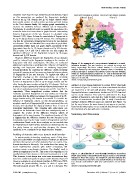
should be much lower for two randomly selected domains. Based          Figure 10. An example of a cross-domain interface in a multi-
on this assumption, we analyzed the fingerprints similarity            interface domain. The two interfaces are colored by orange and
between the Ig VH domain and Ig VL kappa domain which                  forest, respectively. The forest colored interface is a cross-domain
have similar number of multi-interface proteins, and both belong       interface formed by the interaction between chain H (rendered by
to the V-set domain family. We employ graph assortativity to           surface) and chain G (rendered by cartoon). Chain H has two domains,
measure the similarity between different sets of fingerprints.         which are Hemochromatosis protein Hfe a-1 and a2 domain (the left
Assortativity is a preferred metric to quantify the equivalence of a   part of chain H) and Hemochromatosis protein Hfe a-3 domain (the
network’s nodes and connections in graph theories. Assortativity       right part of chain H).
between fingerprints of this two domains is calculated using           doi:10.1371/journal.pone.0050821.g010
NetworkX [53]. Figure 9 shows the assortativity of fingerprints in
the Ig VL-kappa domain and Ig VH domain. The null hypothesis           numbers of cross-domain interfaces in various SCOP class levels
says that the assortativity of fingerprints between the two domains    are shown in Figure 11. It can be seen that cross-domain interfaces
are the same. Then we calculated the t-test p-value of graph label-    are favored in azb and a=b proteins. However, cooperative
assortativity (residue type) and graph degree-assortativity of the     fingerprints between cross-domain interfaces at SCOP class level
fingerprints from the Ig VL-kappa domain and Ig VH domain.             can be rarely obtained. This could be attributed to the large
The p-values 1.7e-4 and 1.0e-2 under the two tests suggest the         number of domains in each class (see Table 2) with a very small
significant difference of the fingerprints between Ig VL-kappa         number of cross-domain interfaces (301 in total). Cross-domain
domain and Ig VH domain.                                               interfaces between different classes are observed (see Figure 11),
                                                                       but the ones between the same classes do not appear in our data.
   However, difference between the fingerprints of two domains         Based on this observation, we can conclude that domain is mainly
could be induced by the fingerprint topology or the number of          the functional unit, but with some exceptions.
fingerprints with their combinations. Therefore, we conducted
additional experiments to understand the influence of fingerprint      Summary and Discussion
topology and fingerprint volume on analyzing fingerprints’
domain-specificity by exploring the difference within randomly         Figure 11. Distribution of cross-domain interfaces at various
generated fingerprints and by examining disparity between subsets      SCOP class levels. A line between two classes means a cross-domain
of fingerprints of the two domains. To explore the effect of           interface in these two classes. The weight on each line indicates the
fingerprint topology on this domain-specificity, we randomly           number of instances that have cross-domain interfaces in our data set.
generated two sets of fingerprints with one having an equal            Cross-domain multi-interfaces with very small numbers are not shown
number of fingerprints to that of Ig VL-kappa domain and the           here.
other having the same number as that of Ig VH domain. The t-test       doi:10.1371/journal.pone.0050821.g011
p-values of degree-assortativity and label-assortativity between the
two sets of randomly generated fingerprints are 8.2e-1 and 9.2e-1,
respectively. These insignificant p-values indicate that the
randomly generated fingerprints are very similar; and thus this
test verifies that the difference between the fingerprints of Ig VL-
kappa domain and Ig VH domain is not trivial. To examine the
influence of fingerprint volume on this domain-specificity, we
sampled a small set of fingerprints (50, in our experiment) for each
domain, and calculated the disparity between them in terms of
isomorphic fingerprints. This sampling with replacement was
carried out for thousands of times and were subsequently used to
compute the p-value of the difference between subsets of
fingerprints of the two domains. The significant p-value of 7.0e-
2 suggests that the difference between the two domains is not
dominantly caused by the large number of fingerprints and their
combinations. Based on the above analysis, we can conclude that
the fingerprints of multi-interface domains are domain-specific. As
this study focuses on multi-interface domains, the domain-
specificity is not examined for the single-interface domains.

Profiling of domains with cross-domain multi-interface
   In protein-protein interacting complexes, most of their inter-

faces are located within one single domain. But there are still a few
interfaces that spread over other domains; these are named cross-
domain interfaces in this study. Our results show that among the
2,517 multi-interface proteins with SCOP annotations, 301
proteins contain cross-domain interfaces. The detailed result is
shown in supplement Data S4. This seems a bit surprising as it is
usually believed that domain is the basic functional unit in cell.
This, however, is not always true as in some circumstances they
have to be combined together to play a certain function. Figure 10
shows an example of a cross-domain interface in PDB entry 1DE4,
in which the protein-binding interface in chain G spans over
Hemochromatosis protein Hfe a-1, a-2, and a-3 domains. The

PLOS ONE | www.plosone.org                                             11 December 2012 | Volume 7 | Issue 12 | e50821

