


Page 62 - B.E CSE Curriculum and Syllabus R2017 - REC
P. 62
Department of CSE, REC


                                                                                                     st
               2.  John  Horton,  “Learning  Java  by  Building  Android  Games”,  Packt  Publishing  Limited,  1   edition,
                   2015.
                                                                                                     st
               3.  Jorge Palacios, “Unity 5.x Game AI Programming Cookbook”, Packt Publishing Limited, 1  edition,
                   2016.


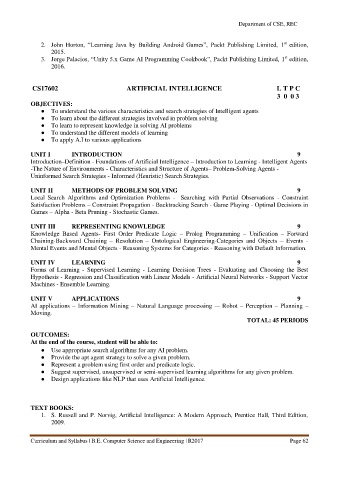
             CS17602                                       ARTIFICIAL INTELLIGENCE                    L T P C
                                                                                                  3  0  0 3
            OBJECTIVES:
               ●  To understand the various characteristics and search strategies of Intelligent agents
               ●  To learn about the different strategies involved in problem solving
               ●  To learn to represent knowledge in solving AI problems
               ●  To understand the different models of learning
               ●  To apply A.I to various applications

            UNIT I        INTRODUCTION                                                                                                   9
            Introduction–Definition - Foundations of Artificial Intelligence – Introduction to Learning - Intelligent Agents
            -The Nature of Environments - Characteristics and Structure of Agents– Problem-Solving Agents -
            Uninformed Search Strategies - Informed (Heuristic) Search Strategies.

            UNIT II       METHODS OF PROBLEM SOLVING                                                             9
            Local  Search  Algorithms  and  Optimization  Problems  -  Searching  with  Partial  Observations  -  Constraint
            Satisfaction Problems – Constraint Propagation - Backtracking Search - Game Playing - Optimal Decisions in
            Games – Alpha - Beta Pruning - Stochastic Games.

            UNIT III      REPRESENTING KNOWLEDGE                                                                             9
            Knowledge  Based  Agents-  First  Order  Predicate  Logic  –  Prolog  Programming  –  Unification  –  Forward
            Chaining-Backward  Chaining  –  Resolution  –  Ontological  Engineering-Categories  and  Objects  –  Events  -
            Mental Events and Mental Objects - Reasoning Systems for Categories - Reasoning with Default Information.

            UNIT IV       LEARNING                                                                                                                9
            Forms  of  Learning  -  Supervised  Learning  -  Learning  Decision  Trees  -  Evaluating  and  Choosing  the  Best
            Hypothesis - Regression and Classification with Linear Models - Artificial Neural Networks - Support Vector
            Machines - Ensemble Learning.

            UNIT V        APPLICATIONS                                                                                                        9
            AI applications – Information Mining  – Natural Language processing  -– Robot – Perception – Planning  –
            Moving.
                                                                                        TOTAL: 45 PERIODS

            OUTCOMES:
            At the end of the course, student will be able to:
               ●  Use appropriate search algorithms for any AI problem.
               ●  Provide the apt agent strategy to solve a given problem.
               ●  Represent a problem using first order and predicate logic.
               ●  Suggest supervised, unsupervised or semi-supervised learning algorithms for any given problem.
               ●  Design applications like NLP that uses Artificial Intelligence.


            TEXT BOOKS:
               1.  S. Russell and P. Norvig, Artificial Intelligence: A Modern Approach, Prentice Hall, Third Edition,
                   2009.


            Curriculum and Syllabus | B.E. Computer Science and Engineering | R2017                    Page 62

