


Page 26 - REC :: M.E. CS Curriculum and Syllabus - R2019
P. 26
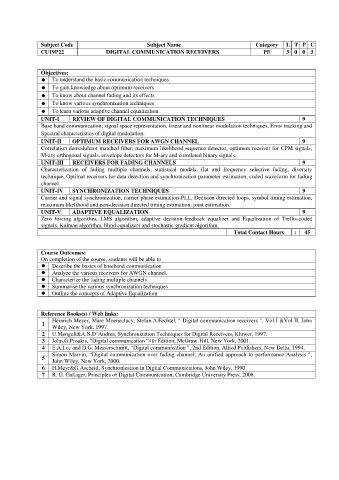
Subject Code Subject Name Category L T P C
CU19P22 DIGITAL COMMUNICATION RECEIVERS PE 3 0 0 3
Objectives:
To understand the basic communication techniques
To gain knowledge about optimum receivers
To know about channel fading and its effects
To know various synchronization techniques
To learn various adaptive channel equalization
UNIT-I REVIEW OF DIGITAL COMMUNICATION TECHNIQUES 9
Base band communication; signal space representation, linear and nonlinear modulation techniques, Error tracking and
Spectral characteristics of digital modulation.
UNIT-II OPTIMUM RECEIVERS FOR AWGN CHANNEL 9
Correlation demodulator matched filter, maximum likelihood sequence detector, optimum receiver for CPM signals,
M-ary orthogonal signals, envelope detectors for M-ary and correlated binary signals.
UNIT-III RECEIVERS FOR FADING CHANNELS 9
Characterization of fading multiple channels, statistical models, flat and frequency selective fading, diversity
technique, Optimal receivers for data detection and synchronization parameter estimation, coded waveform for fading
channel.
UNIT-IV SYNCHRONIZATION TECHNIQUES 9
Carrier and signal synchronization, carrier phase estimation-PLL, Decision directed loops, symbol timing estimation,
maximum likelihood and non-decision directed timing estimation, joint estimation.
UNIT-V ADAPTIVE EQUALIZATION 9
Zero forcing algorithm, LMS algorithm, adaptive decision-feedback equalizer and Equalization of Trellis-coded
signals. Kalman algorithm, blind equalizers and stochastic gradient algorithm.
Total Contact Hours : 45
Course Outcomes:
On completion of the course, students will be able to
Describe the basics of baseband communication
Analyze the various receivers for AWGN channel.
Characterize the fading multiple channels
Summarise the various synchronization techniques
Outline the concepts of Adaptive Equalization
Reference Books(s) / Web links:
Heinrich Meyer, Mare Moeneclacy, Stefan.A.Fechtel, " Digital communication receivers ", Vol I &Vol II, John
1
Wiley, New York, 1997.
2 U.Mengali&A.N.D‟Andrea, Synchronization Techniques for Digital Receivers, Kluwer, 1997.
3 John.G.Proakis, “Digital communication “4th Edition, McGraw-Hill, New York, 2001.
4 E.A.Lee and D.G. Messerschmitt, “Digital communication ", 2nd Edition, Allied Publishers, New Delhi, 1994.
Simon Marvin, “Digital communication over fading channel; An unified approach to performance Analysis ",
5
John Wiley, New York, 2000.
6 H.Meyr&G.Ascheid, Synchronization in Digital Communications, John Wiley, 1990.
7 R. G. Gallager, Principles of Digital Communication, Cambridge University Press, 2008.

