


Page 38 - REC :: All Dept Open Electives
P. 38
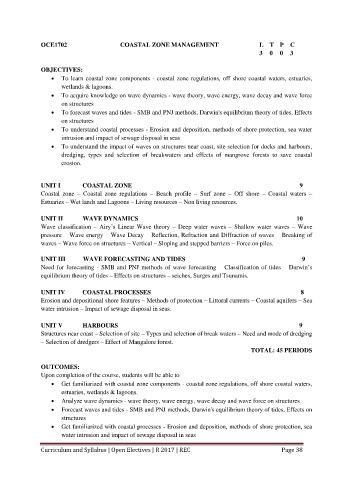
OCE1702 COASTAL ZONE MANAGEMENT L T P C
3 0 0 3
OBJECTIVES:
To learn coastal zone components - coastal zone regulations, off shore coastal waters, estuaries,
wetlands & lagoons.
To acquire knowledge on wave dynamics - wave theory, wave energy, wave decay and wave force
on structures
To forecast waves and tides - SMB and PNJ methods, Darwin's equilibrium theory of tides, Effects
on structures
To understand coastal processes - Erosion and deposition, methods of shore protection, sea water
intrusion and impact of sewage disposal in seas
To understand the impact of waves on structures near coast, site selection for docks and harbours,
dredging, types and selection of breakwaters and effects of mangrove forests to save coastal
erosion.
UNIT I COASTAL ZONE 9
Coastal zone – Coastal zone regulations – Beach profile – Surf zone – Off shore – Coastal waters –
Estuaries – Wet lands and Lagoons – Living resources – Non living resources.
UNIT II WAVE DYNAMICS 10
Wave classification – Airy‘s Linear Wave theory – Deep water waves – Shallow water waves – Wave
pressure – Wave energy – Wave Decay – Reflection, Refraction and Diffraction of waves – Breaking of
waves – Wave force on structures – Vertical – Sloping and stepped barriers – Force on piles.
UNIT III WAVE FORECASTING AND TIDES 9
Need for forecasting - SMB and PNJ methods of wave forecasting – Classification of tides – Darwin‘s
equilibrium theory of tides – Effects on structures – seiches, Surges and Tsunamis.
UNIT IV COASTAL PROCESSES 8
Erosion and depositional shore features – Methods of protection – Littoral currents – Coastal aquifers – Sea
water intrusion – Impact of sewage disposal in seas.
UNIT V HARBOURS 9
Structures near coast – Selection of site – Types and selection of break waters – Need and mode of dredging
– Selection of dredgers – Effect of Mangalore forest.
TOTAL: 45 PERIODS
OUTCOMES:
Upon completion of the course, students will be able to
Get familiarized with coastal zone components - coastal zone regulations, off shore coastal waters,
estuaries, wetlands & lagoons.
Analyze wave dynamics - wave theory, wave energy, wave decay and wave force on structures
Forecast waves and tides - SMB and PNJ methods, Darwin's equilibrium theory of tides, Effects on
structures
Get familiarized with coastal processes - Erosion and deposition, methods of shore protection, sea
water intrusion and impact of sewage disposal in seas
Curriculum and Syllabus | Open Electives | R 2017 | REC Page 38

