


Page 11 - REC :: MBA CURRICULUM AND SYLLABUS :: R2019
P. 11
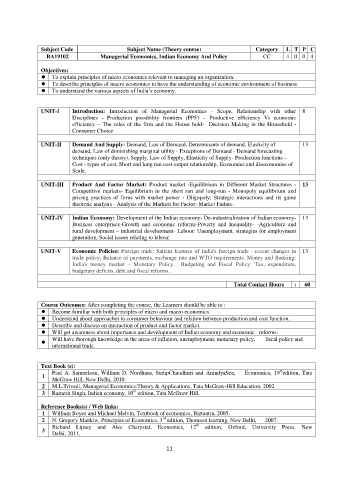
Subject Code Subject Name (Theory course) Category L T P C
BA19102 Managerial Economics, Indian Economy And Policy CC 4 0 0 4
Objectives:
To explain principles of micro economics relevant to managing an organization.
To describe principles of macro economics to have the understanding of economic environment of business.
To understand the various aspects of India’s economy.
UNIT-I Introduction: Introduction of Managerial Economics - Scope, Relationship with other 8
Disciplines - Production possibility frontiers (PPF) – Productive efficiency Vs economic
efficiency – The roles of the firm and the House hold- Decision Making in the Household -
Consumer Choice
UNIT-II Demand And Supply: Demand, Law of Demand, Determinants of demand, Elasticity of 13
demand, Law of diminishing marginal utility - Exceptions of Demand - Demand forecasting
techniques (only theory). Supply, Law of Supply, Elasticity of Supply- Production functions –
Cost - types of cost, Short and long run cost output relationship, Economies and diseconomies of
Scale.
UNIT-III Product And Factor Market: Product market -Equilibrium in Different Market Structures - 13
Competitive markets- Equilibrium in the short run and long-run - Monopoly equilibrium and
pricing practices of firms with market power - Oligopoly: Strategic interactions and its game
theoretic analysis - Analysis of the Markets for Factor- Market Failure.
UNIT-IV Indian Economy: Development of the Indian economy- De-industrialization of Indian economy- 13
Business enterprises-Growth and economic reforms-Poverty and Inequality- -Agriculture and
rural development – industrial development- Labour: Unemployment, strategies for employment
generation, Social issues relating to labour.
UNIT-V Economic Policies: Foreign trade: Salient features of India's foreign trade - recent changes in 13
trade policy; Balance of payments, exchange rate and WTO requirements. Money and Banking:
India's money market – Monetary Policy. Budgeting and Fiscal Policy: Tax, expenditure,
budgetary deficits, debt and fiscal reforms.
Total Contact Hours : 60
Course Outcomes: After completing the course, the Learners should be able to :
Become familiar with both principles of micro and macro economics.
Understand about approaches to consumer behaviour and relation between production and cost function.
Describe and discuss on interaction of product and factor market.
Will get awareness about importance and development of Indian economy and economic reforms.
Will have thorough knowledge in the areas of inflation, unemployment, monetary policy, fiscal policy and
international trade.
Text Book (s):
th
Paul A. Samuelson, William D. Nordhaus, SudipChaudhuri and AnindyaSen, Economics, 19 edition, Tata
1
McGraw Hill, New Delhi, 2010.
2 M.L.Trivedi, Managerial Economics:Theory & Applications, Tata McGraw-Hill Education, 2002.
th
3 Ramesh Singh, Indian economy, 10 edition, Tata McGraw Hill.
Reference Books(s) / Web links:
1 William Boyes and Michael Melvin, Textbook of economics, Biztantra, 2005.
rd
2 N. Gregory Mankiw, Principles of Economics, 3 edition, Thomson learning, New Delhi, 2007.
th
Richard Lipsey and Alec Charystal, Economics, 12 edition, Oxford, University Press, New
3
Delhi, 2011.
11

