


Page 16 - REC :: MBA CURRICULUM AND SYLLABUS :: R2019
P. 16
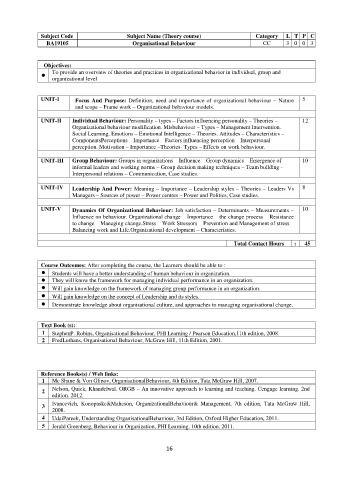
Subject Code Subject Name (Theory course) Category L T P C
BA19105 Organisational Behaviour CC 3 0 0 3
Objectives:
To provide an overview of theories and practices in organizational behavior in individual, group and
organizational level
UNIT-I Focus And Purpose: Definition, need and importance of organizational behaviour – Nature 5
and scope – Frame work – Organizational behaviour models.
UNIT-II Individual Behaviour: Personality – types – Factors influencing personality – Theories – 12
Organizational behaviour modification. Misbehaviour – Types – Management Intervention.
Social Learning. Emotions – Emotional Intelligence – Theories. Attitudes – Characteristics –
ComponentsPerceptions – Importance – Factors influencing perception – Interpersonal
perception. Motivation – Importance –Theories- Types – Effects on work behaviour.
UNIT-III Group Behaviour: Groups in organizations – Influence – Group dynamics – Emergence of 10
informal leaders and working norms – Group decision making techniques – Team building -
Interpersonal relations – Communication, Case studies.
UNIT-IV Leadership And Power: Meaning – Importance – Leadership styles – Theories – Leaders Vs 8
Managers – Sources of power – Power centres – Power and Politics, Case studies.
UNIT-V Dynamics Of Organizational Behaviour: Job satisfaction – Determinants – Measurements – 10
Influence on behaviour. Organizational change – Importance – the change process – Resistance
to change – Managing change.Stress – Work Stressors – Prevention and Management of stress –
Balancing work and Life.Organizational development – Characteristics.
Total Contact Hours : 45
Course Outcomes: After completing the course, the Learners should be able to :
Students will have a better understanding of human behaviour in organization.
They will know the framework for managing individual performance in an organization.
Will gain knowledge on the framework of managing group performance in an organization.
Will gain knowledge on the concept of Leadership and its styles.
Demonstrate knowledge about organisational culture, and approaches to managing organisational change.
Text Book (s):
1 StephenP. Robins, Organisational Behaviour, PHI Learning / Pearson Education,11th edition, 2008.
2 FredLuthans, Organisational Behaviour, McGraw Hill, 11th Edition, 2001.
Reference Books(s) / Web links:
1 Mc Shane & Von Glinov, OrganisationalBehaviour, 4th Edition, Tata McGraw Hill, 2007.
Nelson, Quick, Khandelwal. ORGB – An innovative approach to learning and teaching. Cengage learning. 2nd
2
edition. 2012.
Ivancevich, Konopaske&Maheson, OrganizationalBehaviour& Management, 7th edition, Tata McGraw Hill,
3
2008.
4 UdaiPareek, Understanding OrganisationalBehaviour, 3rd Edition, Oxford Higher Education, 2011.
5 Jerald Greenberg, Behaviour in Organization, PHI Learning. 10th edition. 2011.
16

