


Page 13 - REC :: MBA CURRICULUM AND SYLLABUS :: R2019
P. 13
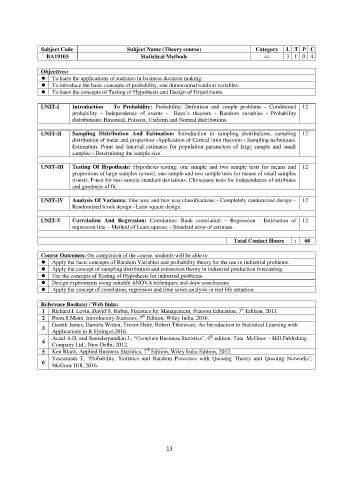
Subject Code Subject Name (Theory course) Category L T P C
BA19103 Statistical Methods cc 3 1 0 4
Objectives:
To learn the applications of statistics in business decision making.
To introduce the basic concepts of probability, one dimensional random variables.
To learn the concepts of Testing of Hypothesis and Design of Experiments.
UNIT-I Introduction To Probability: Probability: Definition and simple problems - Conditional 12
probability - Independence of events - Baye’s theorem - Random variables - Probability
distributions: Binomial, Poisson, Uniform and Normal distributions.
UNIT-II Sampling Distribution And Estimation: Introduction to sampling distributions, sampling 12
distribution of mean and proportion -Application of Central limit theorem - Sampling techniques.
Estimation: Point and Interval estimates for population parameters of large sample and small
samples - Determining the sample size.
UNIT-III Testing Of Hypothesis: Hypothesis testing: one sample and two sample tests for means and 12
proportions of large samples (z-test), one sample and two sample tests for means of small samples
(t-test), F-test for two sample standard deviations. Chi-square tests for independence of attributes
and goodness of fit.
UNIT-IV Analysis Of Variance: One way and two way classifications - Completely randomized design – 12
Randomized block design –Latin square design.
UNIT-V Correlation And Regression: Correlation- Rank correlation – Regression : Estimation of 12
regression line – Method of Least squares – Standard error of estimate.
Total Contact Hours : 60
Course Outcomes: On completion of the course, students will be able to
Apply the basic concepts of Random Variables and probability theory for the use in industrial problems.
Apply the concept of sampling distribution and estimation theory in industrial production forecasting.
Use the concepts of Testing of Hypothesis for industrial problems.
Design experiments using suitable ANOVA techniques and draw conclusions.
Apply the concept of correlation, regression and time series analysis in real life situation.
Reference Books(s) / Web links:
th
1 Richard I. Levin, David S. Rubin, Statistics for Management, Pearson Education, 7 Edition, 2011.
th
2 Prem.S.Mann, Introductory Statistics, 7 Edition, Wiley India, 2016.
Gareth James, Daniela Witten, Trevor Hstie, Robert Tibshirani, An Introduction to Statistical Learning with
3
Applications in R.Springer,2016.
th
Aczel A.D. and Sounderpandian J., “Complete Business Statistics”, 6 edition, Tata McGraw – Hill Publishing
4
Company Ltd., New Delhi, 2012.
th
5 Ken Black, Applied Business Statistics, 7 Edition, Wiley India Edition, 2012.
Veerarajan T, ‘Probability, Statistics and Random Processes with Queuing Theory and Queuing Networks’,
6
McGraw Hill, 2016.
13

