


Page 34 - REC :: MBA CURRICULUM AND SYLLABUS :: R2019
P. 34
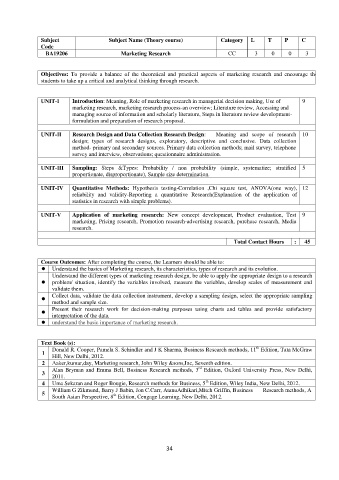
Subject Subject Name (Theory course) Category L T P C
Code
BA19206 Marketing Research CC 3 0 0 3
Objectives: To provide a balance of the theoretical and practical aspects of marketing research and encourage the
students to take up a critical and analytical thinking through research.
UNIT-I Introduction: Meaning, Role of marketing research in managerial decision making, Use of 9
marketing research, marketing research process-an overview; Literature review, Accessing and
managing source of information and scholarly literature, Steps in literature review development-
formulation and preparation of research proposal.
UNIT-II Research Design and Data Collection Research Design: Meaning and scope of research 10
design; types of research designs, exploratory, descriptive and conclusive. Data collection
method- primary and secondary sources. Primary data collection methods; mail survey, telephone
survey and interview, observations; questionnaire administration.
UNIT-III Sampling: Steps &Types: Probability / non probability (simple, systematize; stratified 5
proportionate, disproportionate), Sample size determination.
UNIT-IV Quantitative Methods: Hypothesis testing-Correlation ,Chi square test, ANOVA(one way), 12
reliability and validity-Reporting a quantitative Research(Explanation of the application of
statistics in research with simple problems).
UNIT-V Application of marketing research: New concept development, Product evaluation, Test 9
marketing, Pricing research, Promotion research-advertising research, purchase research, Media
research.
Total Contact Hours : 45
Course Outcomes: After completing the course, the Learners should be able to:
Understand the basics of Marketing research, its characteristics, types of research and its evolution.
Understand the different types of marketing research design, be able to apply the appropriate design to a research
problem/ situation, identify the variables involved, measure the variables, develop scales of measurement and
validate them.
Collect data, validate the data collection instrument, develop a sampling design, select the appropriate sampling
method and sample size.
Present their research work for decision-making purposes using charts and tables and provide satisfactory
interpretation of the data.
understand the basic importance of marketing research.
Text Book (s):
th
Donald R. Cooper, Pamela S. Schindler and J K Sharma, Business Research methods, 11 Edition, Tata McGraw
1
Hill, New Delhi, 2012.
2 Aaker,kumar,day, Marketing research, John Wiley &sons,Inc, Seventh edition.
rd
Alan Bryman and Emma Bell, Business Research methods, 3 Edition, Oxford University Press, New Delhi,
3
2011.
th
4 Uma Sekaran and Roger Bougie, Research methods for Business, 5 Edition, Wiley India, New Delhi, 2012.
William G Zikmund, Barry J Babin, Jon C.Carr, AtanuAdhikari,Mitch Griffin, Business Research methods, A
5 th
South Asian Perspective, 8 Edition, Cengage Learning, New Delhi, 2012.
34

