


Page 57 - REC :: MBA CURRICULUM AND SYLLABUS :: R2019
P. 57
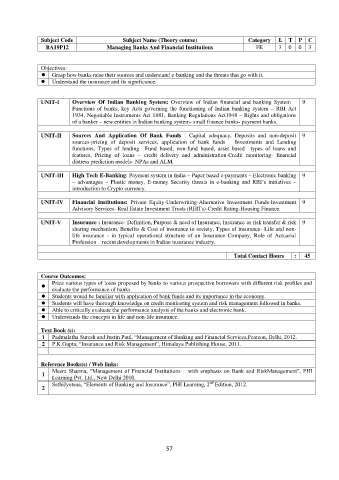
Subject Code Subject Name (Theory course) Category L T P C
BA19P12 Managing Banks And Financial Institutions FE 3 0 0 3
Objectives:
Grasp how banks raise their sources and understand e-banking and the threats that go with it.
Understand the insurance and its significance.
UNIT-I Overview Of Indian Banking System: Overview of Indian financial and banking System – 9
Functions of banks, key Acts governing the functioning of Indian banking system – RBI Act
1934, Negotiable Instruments Act 1881, Banking Regulations Act1948 – Rights and obligations
of a banker – new entities in Indian banking system- small finance banks- payment banks.
UNIT-II Sources And Application Of Bank Funds : Capital adequacy, Deposits and non-deposit 9
sources-pricing of deposit services, application of bank funds – Investments and Lending
functions, Types of lending– Fund based, non-fund based, asset based –types of loans and
features, Pricing of loans – credit delivery and administration-Credit monitoring- financial
distress prediction models- NPAs and ALM.
UNIT-III High Tech E-Banking: Payment system in India – Paper based e-payments – Electronic banking 9
– advantages – Plastic money, E-money Security threats in e-banking and RBI’s initiatives –
introduction to Crypto currency.
UNIT-IV Financial Institutions: Private Equity-Underwriting-Alternative Investment Funds-Investment 9
Advisory Services- Real Estate Investment Trusts (REITs)-Credit Rating-Housing Finance.
UNIT-V Insurance : Insurance- Definition, Purpose & need of Insurance, Insurance as risk transfer & risk 9
sharing mechanism, Benefits & Cost of insurance to society, Types of insurance- Life and non-
life insurance - in typical operational structure of an Insurance Company, Role of Actuarial
Profession – recent developments in Indian insurance industry.
Total Contact Hours : 45
Course Outcomes:
Price various types of loans proposed by banks to various prospective borrowers with different risk profiles and
evaluate the performance of banks.
Students would be familiar with application of bank funds and its importance in the economy.
Students will have thorough knowledge on credit monitoring system and risk management followed in banks.
Able to critically evaluate the performance analysis of the banks and electronic bank.
Understands the concepts in life and non-life insurance.
Text Book (s):
1 Padmalatha Suresh and Justin Paul, “Management of Banking and Financial Services,Pearson, Delhi, 2012.
2 P.K.Gupta, “Insurance and Risk Management”, Himalaya Publishing House, 2011.
Reference Books(s) / Web links:
Meera Sharma, “Management of Financial Institutions – with emphasis on Bank and RiskManagement”, PHI
1
Learning Pvt. Ltd., New Delhi 2010.
nd
SethiJyotsna, “Elements of Banking and Insurance”, PHI Learning, 2 Edition, 2012.
2
57

