


Page 63 - REC :: MBA CURRICULUM AND SYLLABUS :: R2019
P. 63
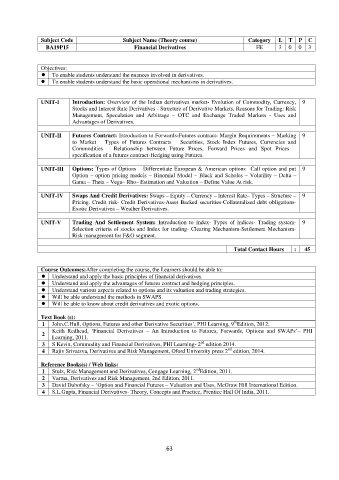
Subject Code Subject Name (Theory course) Category L T P C
BA19P15 Financial Derivatives FE 3 0 0 3
Objectives:
To enable students understand the nuances involved in derivatives.
To enable students understand the basic operational mechanisms in derivatives.
UNIT-I Introduction: Overview of the Indian derivatives market- Evolution of Commodity, Currency, 9
Stocks and Interest Rate Derivatives - Structure of Derivative Markets, Reasons for Trading: Risk
Management, Speculation and Arbitrage – OTC and Exchange Traded Markets - Uses and
Advantages of Derivatives.
UNIT-II Futures Contract: Introduction to Forwards-Futures contract- Margin Requirements – Marking 9
to Market – Types of Futures Contracts – Securities, Stock Index Futures, Currencies and
Commodities – Relationship between Future Prices, Forward Prices and Spot Prices –
specification of a futures contract-Hedging using Futures.
UNIT-III Options: Types of Options – Differentiate European & American options– Call option and put 9
Option – option pricing models – Binomial Model – Black and Scholes – Volatility – Delta –
Gama – Theta – Vega– Rho– Estimation and Valuation – Define Value At risk.
UNIT-IV Swaps And Credit Derivatives: Swaps – Equity – Currency – Interest Rate– Types – Structure – 9
Pricing. Credit risk- Credit Derivatives-Asset Backed securities-Collateralized debt obligations-
Exotic Derivatives – Weather Derivatives.
UNIT-V Trading And Settlement System: Introduction to Index- Types of Indices- Trading system- 9
Selection criteria of stocks and Index for trading- Clearing Mechanism-Settlement Mechanism-
Risk management for F&O segment.
Total Contact Hours : 45
Course Outcomes:After completing the course, the Learners should be able to:
Understand and apply the basic principles of financial derivatives.
Understand and apply the advantages of futures contract and hedging principles.
Understand various aspects related to options and its valuation and trading strategies.
Will be able understand the methods in SWAPS.
Will be able to know about credit derivatives and exotic options.
Text Book (s):
th
1 John.C.Hull, Options, Futures and other Derivative Securities’, PHI Learning, 9 Edition, 2012.
Keith Redhead, ‘Financial Derivatives – An Introduction to Futures, Forwards, Options and SWAPs’– PHI
2
Learning, 2011.
nd
3 S Kevin, Commodity and Financial Derivatives, PHI Learning- 2 edition 2014.
nd
4 Rajiv Srivatsva, Derivatives and Risk Management, Oford University press 2 edition, 2014.
Reference Books(s) / Web links:
nd
1 Stulz, Risk Management and Derivatives, Cengage Learning, 2 Edition, 2011.
2 Varma, Derivatives and Risk Management, 2nd Edition, 2011.
3 David Dubofsky – ‘Option and Financial Futures – Valuation and Uses, McGraw Hill International Edition.
4 S.L.Gupta, Financial Derivatives- Theory, Concepts and Practice, Prentice Hall Of India, 2011.
63

