


Page 83 - REC :: MBA CURRICULUM AND SYLLABUS :: R2019
P. 83
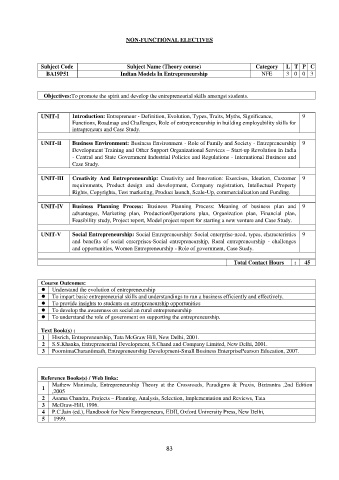
NON-FUNCTIONAL ELECTIVES
Subject Code Subject Name (Theory course) Category L T P C
BA19P51 Indian Models In Entrepreneurship NFE 3 0 0 3
Objectives:To promote the spirit and develop the entrepreneurial skills amongst students.
UNIT-I Introduction: Entrepreneur - Definition, Evolution, Types, Traits, Myths, Significance, 9
Functions, Roadmap and Challenges, Role of entrepreneurship in building employability skills for
intrapreneurs and Case Study.
UNIT-II Business Environment: Business Environment - Role of Family and Society - Entrepreneurship 9
Development Training and Other Support Organizational Services – Start-up Revolution In India
- Central and State Government Industrial Policies and Regulations - International Business and
Case Study.
UNIT-III Creativity And Entrepreneurship: Creativity and Innovation: Exercises, Ideation, Customer 9
requirements, Product design and development, Company registration, Intellectual Property
Rights, Copyrights, Test marketing, Product launch, Scale-Up, commercialization and Funding.
UNIT-IV Business Planning Process: Business Planning Process: Meaning of business plan and 9
advantages, Marketing plan, Production/Operations plan, Organization plan, Financial plan,
Feasibility study, Project report, Model project report for starting a new venture and Case Study.
UNIT-V Social Entrepreneurship: Social Entrepreneurship: Social enterprise-need, types, characteristics 9
and benefits of social enterprises-Social entrepreneurship, Rural entrepreneurship - challenges
and opportunities, Women Entrepreneurship - Role of government, Case Study.
Total Contact Hours : 45
Course Outcomes:
Understand the evolution of entrepreneurship
To impart basic entrepreneurial skills and understandings to run a business efficiently and effectively.
To provide insights to students on entrepreneurship opportunities
To develop the awareness on social an rural entrepreneurship
To understand the role of government on supporting the entrepreneurship.
Text Book(s) :
1 Hisrich, Entrepreneurship, Tata McGraw Hill, New Delhi, 2001.
2 S.S.Khanka, Entrepreneurial Development, S.Chand and Company Limited, New Delhi, 2001.
3 PoornimaCharantimath, Entrepreneurship Development-Small Business EnterprisePearson Education, 2007.
Reference Books(s) / Web links:
Mathew Manimala, Entrepreneurship Theory at the Crossroads, Paradigms & Praxis, Biztrantra ,2nd Edition
1
,2005
2 Asama Chandra, Projects – Planning, Analysis, Selection, Implementation and Reviews, Tata
3 McGraw-Hill, 1996.
4 P.C.Jain (ed.), Handbook for New Entrepreneurs, EDII, Oxford University Press, New Delhi,
5 1999.
83

