


Page 388 - Applied Statistics with R
P. 388
388    CHAPTER 16. VARIABLE SELECTION AND MODEL BUILDING


                                 We can see that the solid blue curve models this data rather nicely. The dashed
                                 orange curve fits the points better, making smaller errors, however it is unlikely
                                 that it is correctly modeling the true relationship between    and   . It is fitting
                                 the random noise. This is an example of overfitting.
                                 We see that the larger model indeed has a lower RMSE.


                                 sqrt(mean(resid(fit_quad) ^ 2))


                                 ## [1] 17.61812

                                 sqrt(mean(resid(fit_big) ^ 2))


                                 ## [1] 10.4197

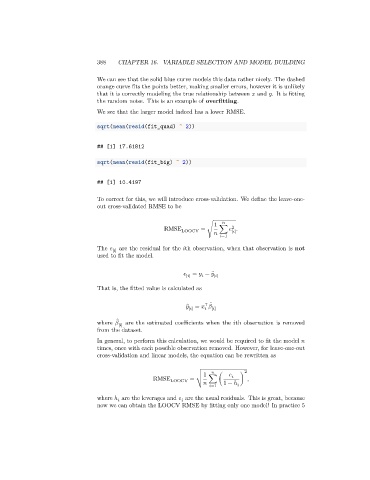
                                 To correct for this, we will introduce cross-validation. We define the leave-one-
                                 out cross-validated RMSE to be


                                                                        1
                                                                              2
                                                       RMSE  LOOCV  = √   ∑    .
                                                                              [  ]
                                                                            =1
                                 The    [  ]  are the residual for the   th observation, when that observation is not
                                 used to fit the model.


                                                                 [  ]  =    − ̂ [  ]


                                 That is, the fitted value is calculated as

                                                                     ⊤ ̂
                                                                ̂
                                                               [  ]  =       [  ]

                                        ̂
                                 where    [  ]  are the estimated coefficients when the   th observation is removed
                                 from the dataset.
                                 In general, to perform this calculation, we would be required to fit the model
                                 times, once with each possible observation removed. However, for leave-one-out
                                 cross-validation and linear models, the equation can be rewritten as

                                                                  √               2
                                                                  √ 1
                                                                  √
                                                    RMSE LOOCV  =     ∑ (         ) ,
                                                                  ⎷       =1  1 − ℎ
                                 where ℎ are the leverages and    are the usual residuals. This is great, because


                                 now we can obtain the LOOCV RMSE by fitting only one model! In practice 5

