


Page 25 - 1964
P. 25
HISTORY
Only six members of the original pre-primary and blurted out the absolute edict that the class would
class had the inner strength to endure the tribula remain inside for a week during recess periods. Then
tions of thirteen rigorous scholastic years at Moses she asked, "Who did it?” Tom Keeney replied, "I
Brown. These boys are Paul Chaset, Warren Hill, did it, Mrs. Kenyon.” Tom Keeney went out to re
Dwight Owen, John Steere, Thomas Steere, and cess that week.
Peter Stevens. Perhaps this courage came from the At the beginning of the third grade year we were
gentle teaching methods of Miss Otla Woodbury. fearful, for here we were confronted with a violent
Let us look back to 1951. Behold the infants romp disciplinarian, Miss Harriet Wilson. She cracked
ing in the sandboxes and denting the skulls of their rulers and had a whip at her disposal for necessary
peers with carpentry-class hammers! beatings, and she smashed heads with dictionaries
Pre-primary was not all amusement, however, for •— so said the rumors. Miss Wilson had a powerful
it was in this year that we were introduced to the voice, one which could quickly impose silence. But
incomparable Dick and ]ane reader. " 'Let us run. we gradually learned that behind that veneer of
Let us play. I see the ball,’ said Dick. The ball is roughness was a kind and gentle woman, one who
red,’ said Jane.’’ The denouement of the complex loved us and was concerned with our problems. Miss
plot must remain untold here. Wilson taught us that "the bark is worse than the
In the first grade Miss Eastman introduced us to bite.”
true academic labor and also to elaborate moral pre The fourth grade was the year in which we were
cepts. "It is all right to be funny, but not to be introduced to tree essays. Some boys diligently car
silly,” said the patient schoolmistress! To this day, ried out the boring essay assignment; others never
many of us find it hard to distinguish between vary took part in this drudgery. The indifference of this
ing degrees of frivolity. small minority remained unnoticed by the school
The second grade contributed in a different way officials, for the judges most likely assumed that the
toward our increasing sense of maturity. Mrs. Ken undone essays were in the ash can with all of the
yon taught us the principles of justice. Tom Keeney, other unsuccessful entries. Except for the tree essay
who long ago left this institution, emitted a piercing contest, Mrs. Bachman’s fourth grade was a wonder
noise of some kind right in the middle of class. Mrs. ful year— somewhat lacking in discipline, maybe in
Kenyon whirled around from her black-board labor contrast to the severe third grade— but perhaps for
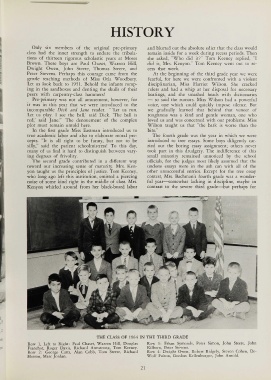
THE CLASS OF 1964 IN THE THIRD GRADE
Row 1, Left to Right: Paul Chaset, Warren Hill, Douglas Row 3: Ethan Symonds, Peter Simon, John Steere, John
Franchot, Roger Davis, Richard Armstrong, Tom Keeney. Kilborn, Peter Stevens.
Row 2: George Cutts, Alan Cobb, Tom Steere, Richard Row 4: Dwight Owen, Robert Ridgely, Steven Cohen, De-
Hutton, Marc Jordan. W olf Fulton, Gordon Kellenburger, John Arnold.

