


Page 30 - 1980
P. 30
hoveling, connecting cables, and
filling up the empty spaces to pack
S the cables down firmly; this was all part of
Ralston homes
getting cable TV,
one of the many
branches of mass WMCH IT!
media.
Not only had
cable come to
Ralston, but air transmitted movie sta
tions such as Vue (Limelight) were also
introduced.
The main difference between cable and
Vue was mode of reception: since Vue is
sent by air waves one needed an antenna
installed on the roof to pick up the sig
nals. Cable is placed underground in the
yard, its waves being sent by wire instead
of air. Both types cost around $15 a
month.
TV was not the only branch of mass
media that was trying to expand. Radio
used gimmicks to reach a larger audi
ence. Sweet 98 held a contest with the
grand prize of a new car and a job for a
year as a disc jockey on their station. This
contest was won by alumnus Alan Bone.
Such contests were typical of a lot of
radio stations that wanted to capture the
audience’s attention.
In mass media and film study classes
students learned how media such as TV,
radio, and films affect their habits and
lifestyles. In these classes they learned
that no one can honestly say that he is not
affected by any form of mass media, —
unless, of course, he was a hermit.
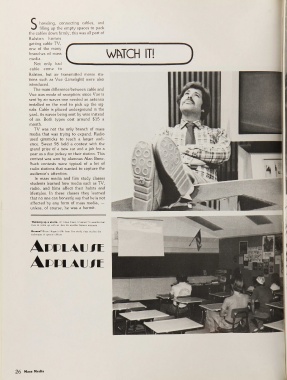
Thinking up a storm . Dr Dave Eiser, Channel 7 ’s weatherman
tries to come up with an idea for another bizarre entrance
Reruns? Rosie Hogan’s fifth hour film study class studies the
technique of special effects
A p p la iie
A dPL/UJIE

