


Page 598 - First Aid for the USMLE Step 1 2020, Thirtieth edition [MedicalBooksVN.com]_Neat
P. 598
554        sEctiON iii    Psychiatry  ` Psychiatry—Psychology                                                                                                            Psychiatry  ` Psychiatry—Psychology


                `  Psychiatry—Psychology

               Classical conditioning  Learning in which a natural response    Usually elicits involuntary responses.
                                       (salivation) is elicited by a conditioned,   Pavlov’s classical experiments with dogs—
                                       or learned, stimulus (bell) that previously   ringing the bell provoked salivation.
                                       was presented in conjunction with an
                                       unconditioned stimulus (food).


               Operant conditioning  Learning in which a particular action is elicited because it produces a punishment or reward.
                                       Usually elicits voluntary responses.
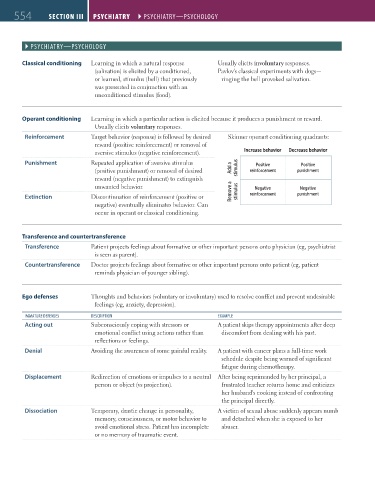
                Reinforcement        Target behavior (response) is followed by desired   Skinner operant conditioning quadrants:
                                      reward (positive reinforcement) or removal of
                                      aversive stimulus (negative reinforcement).      Increase behavior  Decrease behavior
                Punishment           Repeated application of aversive stimulus             Positive       Positive
                                      (positive punishment) or removal of desired   Add a  stimulus  reinforcement  punishment
                                      reward (negative punishment) to extinguish
                                      unwanted behavior.                                   Negative       Negative
                Extinction           Discontinuation of reinforcement (positive or   Remove a  stimulus  reinforcement  punishment
                                      negative) eventually eliminates behavior. Can
                                      occur in operant or classical conditioning.


               Transference and countertransference
                Transference         Patient projects feelings about formative or other important persons onto physician (eg, psychiatrist
                                       is seen as parent).
                Countertransference  Doctor projects feelings about formative or other important persons onto patient (eg, patient
                                       reminds physician of younger sibling).


               Ego defenses          Thoughts and behaviors (voluntary or involuntary) used to resolve conflict and prevent undesirable
                                       feelings (eg, anxiety, depression).

                iMMatUrE DEFENsEs    DEscriPtioN                               EXaMPlE
                Acting out           Subconsciously coping with stressors or   A patient skips therapy appointments after deep
                                       emotional conflict using actions rather than   discomfort from dealing with his past.
                                       reflections or feelings.
                Denial               Avoiding the awareness of some painful reality.   A patient with cancer plans a full-time work
                                                                                schedule despite being warned of significant
                                                                                fatigue during chemotherapy.
                Displacement         Redirection of emotions or impulses to a neutral  After being reprimanded by her principal, a
                                       person or object (vs projection).        frustrated teacher returns home and criticizes
                                                                                her husband's cooking instead of confronting
                                                                                the principal directly.
                Dissociation         Temporary, drastic change in personality,   A victim of sexual abuse suddenly appears numb
                                       memory, consciousness, or motor behavior to   and detached when she is exposed to her
                                       avoid emotional stress. Patient has incomplete   abuser.
                                       or no memory of traumatic event.


          FAS1_2019_13-Psych.indd   554                                                                                 11/7/19   5:28 PM

