


Page 101 - The City and Guilds Textbook: Plumbing Book 1 for the Level 3 Apprenticeship (9189), Level 2 Technical Certificate (8202) and Level 2 Diploma (6035)
P. 101
Chapter 2 Common processes and techniques
● Use a dust mask in dusty conditions and wear hearing protection if the tool
is being used for an extended period of time. Remember: prolonged use of
hammer-type power tools can cause vibration injury.
● Make sure the work area is clean and free of debris that might get in the way,
and always make sure the work area has plenty of light.
● Make sure all appropriate safety guards are in place and never remove a
safety guard.
● Always turn off and unplug the tool before any adjustments or change of
blades takes place.
● Never use power tools in wet or damp conditions.
● Make sure extension cords are the correct type, and don’t use cords designed
for inside use outside.
● Make sure cutters or blades are clean, sharp and securely in place. Never use
bent or broken blades or cutters.
● Never over-reach when using a power tool, and always take care when using
power tools at height.
● When using hand-held power tools, always grip with both hands.
● Always unplug, clean and store the tool in a safe, dry place when the job is
finished.
Drills bits, core drills and hole saws
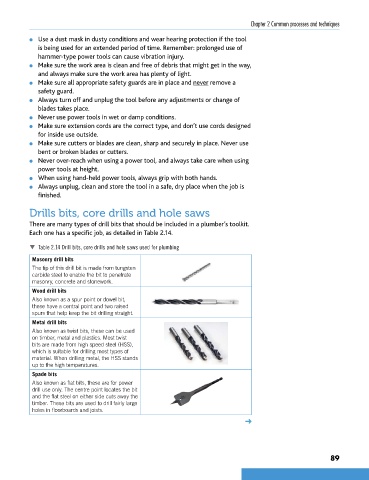
There are many types of drill bits that should be included in a plumber’s toolkit.
Each one has a specific job, as detailed in Table 2.14.
Table 2.14 Drill bits, core drills and hole saws used for plumbing
Masonry drill bits
The tip of this drill bit is made from tungsten
carbide steel to enable the bit to penetrate
masonry, concrete and stonework.
Wood drill bits
Also known as a spur point or dowel bit,
these have a central point and two raised
spurs that help keep the bit drilling straight.
Metal drill bits
Also known as twist bits, these can be used
on timber, metal and plastics. Most twist
bits are made from high speed steel (HSS),
which is suitable for drilling most types of
material. When drilling metal, the HSS stands
up to the high temperatures.
Spade bits
Also known as flat bits, these are for power
drill use only. The centre point locates the bit
and the flat steel on either side cuts away the
timber. These bits are used to drill fairly large
holes in floorboards and joists.
➜
89
9781510416482.indb 89 29/03/19 8:52 PM

