


Page 106 - The City and Guilds Textbook: Plumbing Book 1 for the Level 3 Apprenticeship (9189), Level 2 Technical Certificate (8202) and Level 2 Diploma (6035)
P. 106
Required passover
                                                                            Passover measurement
                                                                                                        1st bend

                                                                            1
                                                                            Close a folding rule down to the passover measurement
                                                                            to obtain the angle for the first bend
                                                                                                       Angle required
                                                                            Passover measurement

                                                                                            600  mm rule
                                                                            2
                                                                            Bend tube to the angle required by the folding rule
                                                                            3
                                                                            Close folding rule down to twice the passover measurement
                                                                            to obtain the angle for the second bend
                                                                            2 × passover
                                                                            measurement

                The City & Guilds Textbook: Plumbing Book 1                                 Angle for second bend
                                                            Required passover  4
                                                                            Mark for the second bend by measuring
                                                                            from the inside edge of tube
                                 Passover measurement
                                                             1st bend       Bending mark
                                                                                                          Passover
                                                                                                          measurement
                                 1                                                           Straight edge
                                 Close a folding rule down to the passover measurement
                                 to obtain the angle for the first bend
                                 Passover measurement       Angle required
                                                                            5
                                                                            Re-position tube in the machine so that
                                                                            mark forms a tangent to the former
                                                 600  mm rule
                                 2
                                 Bend tube to the angle required by the folding rule


                                 3
                                 Close folding rule down to twice the passover measurement
                                 to obtain the angle for the second bend

                                 2 × passover
                                 measurement

                                                 Angle for second bend


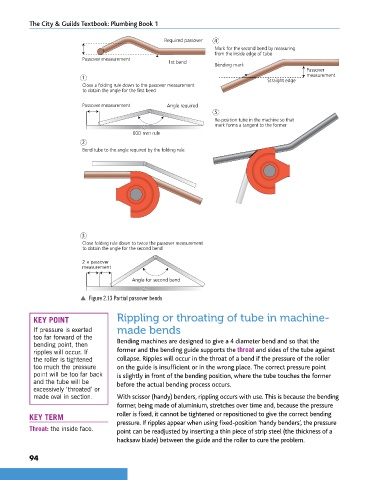
                                p  Figure 2.13 Partial passover bends
                                 4
                                 Mark for the second bend by measuring
                                 from the inside edge of tube
                 KEY POINT                  Rippling or throating of tube in machine-
                                 Bending mark
                 If pressure is exerted     made bends
                                                               Passover
                 too far forward of the           Straight edge  measurement
                 bending point, then        Bending machines are designed to give a 4 diameter bend and so that the
                 ripples will occur. If     former and the bending guide supports the throat and sides of the tube against
                 the roller is tightened    collapse. Ripples will occur in the throat of a bend if the pressure of the roller
                 too much the pressure      on the guide is insufficient or in the wrong place. The correct pressure point
                                 5
                 point will be too far back   is slightly in front of the bending position, where the tube touches the former
                                 Re-position tube in the machine so that
                 and the tube will be       before the actual bending process occurs.
                                 mark forms a tangent to the former
                 excessively ‘throated’ or
                 made oval in section.      With scissor (handy) benders, rippling occurs with use. This is because the bending
                                            former, being made of aluminium, stretches over time and, because the pressure
                KEY TERM                    roller is fixed, it cannot be tightened or repositioned to give the correct bending
                                            pressure. If ripples appear when using fixed-position ‘handy benders’, the pressure
                Throat: the inside face.    point can be readjusted by inserting a thin piece of strip steel (the thickness of a

                                            hacksaw blade) between the guide and the roller to cure the problem.

                94


        9781510416482.indb   94                                                                                     29/03/19   8:52 PM

