


Page 102 - The City and Guilds Textbook: Plumbing Book 1 for the Level 3 Apprenticeship (9189), Level 2 Technical Certificate (8202) and Level 2 Diploma (6035)
P. 102
The City & Guilds Textbook: Plumbing Book 1
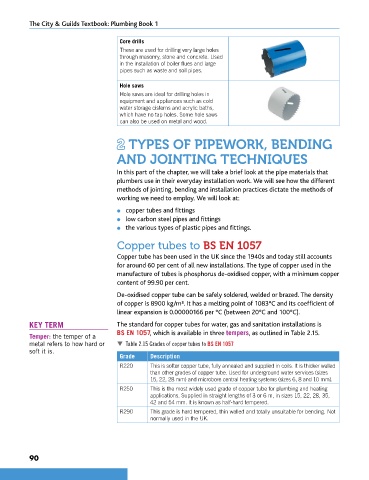
Core drills KEY POINT
These are used for drilling very large holes
through masonry, stone and concrete. Used During your time as a
in the installation of boiler flues and large plumber you will come
pipes such as waste and soil pipes. across many materials,
and each will have its
Hole saws own unique working
Hole saws are ideal for drilling holes in properties, including
equipment and appliances such as cold different melting points
water storage cisterns and acrylic baths, and expansion rates.
which have no tap holes. Some hole saws It is important that
can also be used on metal and wood. we recognise these
properties so that we
can choose the correct
2 TYPES OF PIPEWORK, BENDING material for a given
installation. You will
AND JOINTING TECHNIQUES come across other such
properties as you work
In this part of the chapter, we will take a brief look at the pipe materials that through this book.
plumbers use in their everyday installation work. We will see how the different
methods of jointing, bending and installation practices dictate the methods of
working we need to employ. We will look at:
● copper tubes and fittings
● low carbon steel pipes and fittings
● the various types of plastic pipes and fittings.
Copper tubes to BS EN 1057
Copper tube has been used in the UK since the 1940s and today still accounts
for around 60 per cent of all new installations. The type of copper used in the
manufacture of tubes is phosphorus de-oxidised copper, with a minimum copper
content of 99.90 per cent.
De-oxidised copper tube can be safely soldered, welded or brazed. The density
of copper is 8900 kg/m³. It has a melting point of 1083°C and its coefficient of
linear expansion is 0.00000166 per °C (between 20°C and 100°C).
KEY TERM The standard for copper tubes for water, gas and sanitation installations is
BS EN 1057, which is available in three tempers, as outlined in Table 2.15.
Temper: the temper of a
metal refers to how hard or Table 2.15 Grades of copper tubes to BS EN 1057
soft it is.
Grade Description
R220 This is softer copper tube, fully annealed and supplied in coils. It is thicker walled
than other grades of copper tube. Used for underground water services (sizes
15, 22, 28 mm) and microbore central heating systems (sizes 6, 8 and 10 mm).
R250 This is the most widely used grade of copper tube for plumbing and heating
applications. Supplied in straight lengths of 3 or 6 m, in sizes 15, 22, 28, 35,
42 and 54 mm. It is known as half-hard tempered.
R290 This grade is hard tempered, thin walled and totally unsuitable for bending. Not
normally used in the UK.
90
9781510416482.indb 90 29/03/19 8:52 PM

