


Page 27 - The City and Guilds Textbook: Plumbing Book 1 for the Level 3 Apprenticeship (9189), Level 2 Technical Certificate (8202) and Level 2 Diploma (6035)
P. 27
Chapter 1 Health and safety practices and systems

                ●  Regulations: rules, procedures and administrative codes set by authorities or
                   governmental agencies to achieve an objective. They are legally enforceable
                   and must be followed to avoid prosecution.
                Those that give guidance and advice are:

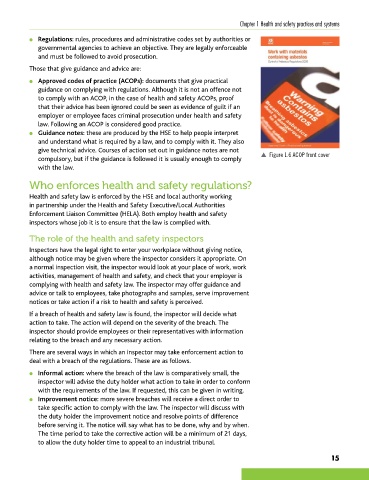
                ●  Approved codes of practice (ACOPs): documents that give practical
                   guidance on complying with regulations. Although it is not an offence not
                   to comply with an ACOP, in the case of health and safety ACOPs, proof
                   that their advice has been ignored could be seen as evidence of guilt if an
                   employer or employee faces criminal prosecution under health and safety
                   law. Following an ACOP is considered good practice.
                ●  Guidance notes: these are produced by the HSE to help people interpret
                   and understand what is required by a law, and to comply with it. They also
                   give technical advice. Courses of action set out in guidance notes are not   p  Figure 1.6 ACOP front cover
                   compulsory, but if the guidance is followed it is usually enough to comply
                   with the law.


                Who enforces health and safety regulations?
                Health and safety law is enforced by the HSE and local authority working
                in partnership under the Health and Safety Executive/Local Authorities
                Enforcement Liaison Committee (HELA). Both employ health and safety
                inspectors whose job it is to ensure that the law is complied with.

                The role of the health and safety inspectors
                Inspectors have the legal right to enter your workplace without giving notice,
                although notice may be given where the inspector considers it appropriate. On
                a normal inspection visit, the inspector would look at your place of work, work
                activities, management of health and safety, and check that your employer is
                complying with health and safety law. The inspector may offer guidance and
                advice or talk to employees, take photographs and samples, serve improvement
                notices or take action if a risk to health and safety is perceived.
                If a breach of health and safety law is found, the inspector will decide what
                action to take. The action will depend on the severity of the breach. The
                inspector should provide employees or their representatives with information
                relating to the breach and any necessary action.

                There are several ways in which an inspector may take enforcement action to
                deal with a breach of the regulations. These are as follows.
                ●  Informal action: where the breach of the law is comparatively small, the
                   inspector will advise the duty holder what action to take in order to conform
                   with the requirements of the law. If requested, this can be given in writing.
                ●  Improvement notice: more severe breaches will receive a direct order to
                   take specific action to comply with the law. The inspector will discuss with
                   the duty holder the improvement notice and resolve points of difference
                   before serving it. The notice will say what has to be done, why and by when.
                   The time period to take the corrective action will be a minimum of 21 days,
                   to allow the duty holder time to appeal to an industrial tribunal.

                                                                                                                 15


        9781510416482.indb   15                                                                                     29/03/19   8:48 PM

