


Page 31 - The City and Guilds Textbook: Plumbing Book 1 for the Level 3 Apprenticeship (9189), Level 2 Technical Certificate (8202) and Level 2 Diploma (6035)
P. 31
Chapter 1 Health and safety practices and systems
● Young children should be protected from the dangers of building sites. Steps
taken should include:
● cover trenches, excavations and scaffolds, removing all ladders
● store materials so there is no risk of them toppling over
● lock away hazardous substances INDUSTRY TIP
● initiate other security methods such as security guards.
● Protect passers-by from falling objects from scaffolds by the use of toe These are just a few of the
precautions you can take but
boards, brick guards and netting. there are many others. For
● Use plastic sheeting to retain dust, drips and splashes. more information, see the HSE
● Tie down or remove loose materials from scaffolds. website at: www.hse.gov.uk
● Ensure that warning and danger signs are posted on and around the scaffold.
Safety signs
Safety signs are used on construction sites where risks have not been avoided
by other means. Employers are required to provide and maintain safety signs,
and workers need to be trained in the recognition of safety signs and symbols
so that they understand their meaning. To ensure that the correct number and
type of safety signs have been used, an employer must carry out a number of
simple tasks. They must:
● conduct a risk assessment
● ensure fire equipment and emergency exits are clearly indicated
● use signs to prohibit entry into dangerous areas
● make sure that mandatory requirements, such as wearing PPE, are clearly
shown
● clearly indicate all first-aid areas and equipment INDUSTRY TIP
● use signs to show prohibited behaviour, such as ‘no smoking’.
You can access more
The signs used must communicate their message clearly and effectively, information on the European
and many have to conform to strict legal and accessibility obligations. Council’s Safety Signs
Safety signs must comply with the European Council’s Safety Signs Directive Directive (92/58/EEC) via:
(92/58/EEC), the purpose of which is to encourage the standardisation of http://eur-lex.europa.eu/legal-
safety signs throughout the European Union so that safety signs have the content/EN/TXT/?uri=
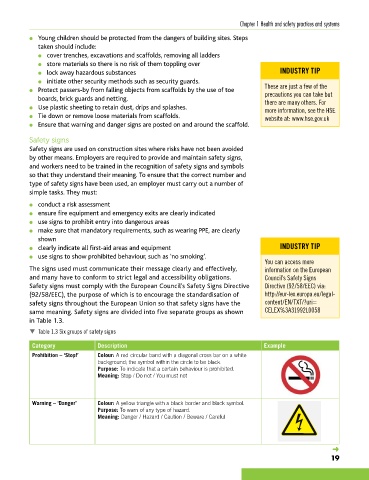
same meaning. Safety signs are divided into five separate groups as shown CELEX%3A31992L0058
in Table 1.3.
Table 1.3 Six groups of safety signs
Category Description Example
Prohibition – ‘Stop!’ Colour: A red circular band with a diagonal cross bar on a white
background; the symbol within the circle to be black.
Purpose: To indicate that a certain behaviour is prohibited.
Meaning: Stop / Do not / You must not
Warning – ‘Danger’ Colour: A yellow triangle with a black border and black symbol.
Purpose: To warn of any type of hazard.
Meaning: Danger / Hazard / Caution / Beware / Careful
➜
19
9781510416482.indb 19 29/03/19 8:49 PM

