


Page 279 - The City and Guilds Textbook: Plumbing Book 1 for the Level 3 Apprenticeship (9189), Level 2 Technical Certificate (8202) and Level 2 Diploma (6035)
P. 279
Chapter 5 Cold water systems

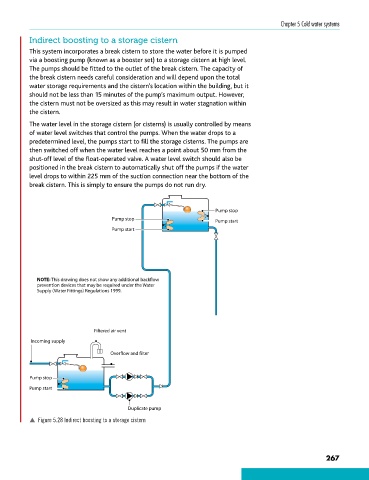
                Indirect boosting to a storage cistern

                This system incorporates a break cistern to store the water before it is pumped
                via a boosting pump (known as a booster set) to a storage cistern at high level.
                The pumps should be fitted to the outlet of the break cistern. The capacity of
                the break cistern needs careful consideration and will depend upon the total
                water storage requirements and the cistern’s location within the building, but it
                should not be less than 15 minutes of the pump’s maximum output. However,
                the cistern must not be oversized as this may result in water stagnation within
                the cistern.

                The water level in the storage cistern (or cisterns) is usually controlled by means
                of water level switches that control the pumps. When the water drops to a
                predetermined level, the pumps start to fill the storage cisterns. The pumps are
                then switched off when the water level reaches a point about 50 mm from the
                shut-off level of the float-operated valve. A water level switch should also be
                positioned in the break cistern to automatically shut off the pumps if the water
                level drops to within 225 mm of the suction connection near the bottom of the
                break cistern. This is simply to ensure the pumps do not run dry.


                                                                            Pump stop
                                           Pump stop                        Pump start
                                           Pump start


                  NOTE: This drawing does not show any additional backflow
                  prevention devices that may be required under the Water
                  Supply (Water Fittings) Regulations 1999.


                                     Filtered air vent
                Incoming supply
                                          Overflow and filter


                Pump stop
                Pump start


                                                Duplicate pump
                p  Figure 5.28 Indirect boosting to a storage cistern


                                                                                                                267


        9781510416482.indb   267                                                                                    29/03/19   8:57 PM

