


Page 281 - The City and Guilds Textbook: Plumbing Book 1 for the Level 3 Apprenticeship (9189), Level 2 Technical Certificate (8202) and Level 2 Diploma (6035)
P. 281
Chapter 5 Cold water systems

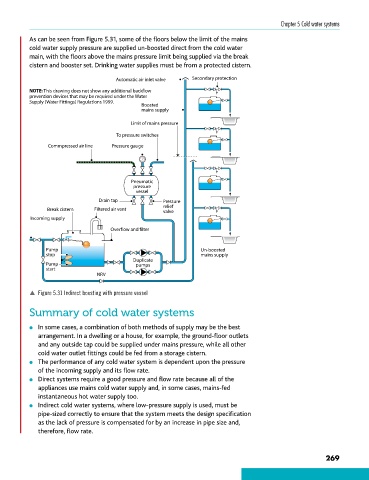
                As can be seen from Figure 5.31, some of the floors below the limit of the mains
                cold water supply pressure are supplied un-boosted direct from the cold water
                main, with the floors above the mains pressure limit being supplied via the break
                cistern and booster set. Drinking water supplies must be from a protected cistern.

                                            Automatic air inlet valve  Secondary protection
                NOTE: This drawing does not show any additional backflow
                prevention devices that may be required under the Water
                Supply (Water Fittings) Regulations 1999.
                                                    Boosted
                                                    mains supply

                                                 Limit of mains pressure
                                            To pressure switches
                      Commpressed air line  Pressure gauge


                                                 Pneumatic
                                                  pressure
                                                  vessel
                                      Drain tap            Pressure
                                                           relief
                      Break cistern  Filtered air vent     valve
                Incoming supply
                                          Overflow and filter


                     Pump                                              Un-boosted
                     stop                                              mains supply
                                                 Duplicate
                     Pump                         pumps
                     start
                                      NRV


                p
                302.06 Figure 5.31 Indirect boosting with pressure vessel
                Summary of cold water systems


                ●  In some cases, a combination of both methods of supply may be the best
                   arrangement. In a dwelling or a house, for example, the ground-floor outlets
                   and any outside tap could be supplied under mains pressure, while all other
                   cold water outlet fittings could be fed from a storage cistern.
                ●  The performance of any cold water system is dependent upon the pressure
                   of the incoming supply and its flow rate.
                ●  Direct systems require a good pressure and flow rate because all of the
                   appliances use mains cold water supply and, in some cases, mains-fed
                   instantaneous hot water supply too.
                ●  Indirect cold water systems, where low-pressure supply is used, must be
                   pipe-sized correctly to ensure that the system meets the design specification
                   as the lack of pressure is compensated for by an increase in pipe size and,
                   therefore, flow rate.


                                                                                                                269


        9781510416482.indb   269                                                                                    29/03/19   8:57 PM

