


Page 406 - The City and Guilds Textbook: Plumbing Book 1 for the Level 3 Apprenticeship (9189), Level 2 Technical Certificate (8202) and Level 2 Diploma (6035)
P. 406
The City & Guilds Textbook: Plumbing Book 1


                                                5


                                                4


                                                3
                                              Bar gauge


                                                2


                                                1


                                                0

                                                    100     110      120      130     140      150      160

                                                        Degrees Celsius 120.2  133.5    143.6  151.8  158.8
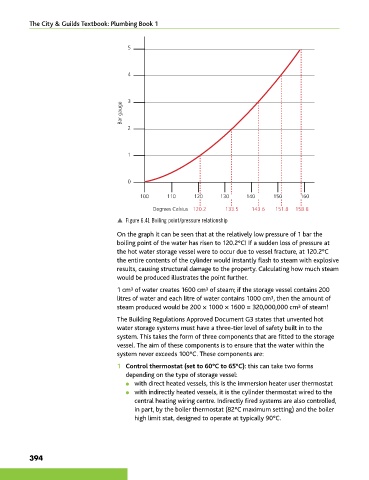
                                            p  Figure 6.41 Boiling point/pressure relationship

                                            On the graph it can be seen that at the relatively low pressure of 1 bar the
                                            boiling point of the water has risen to 120.2°C! If a sudden loss of pressure at
                                            the hot water storage vessel were to occur due to vessel fracture, at 120.2°C
                                            the entire contents of the cylinder would instantly flash to steam with explosive
                                            results, causing structural damage to the property. Calculating how much steam
                                            would be produced illustrates the point further.
                                            1 cm  of water creates 1600 cm  of steam; if the storage vessel contains 200
                                                                         3
                                                 3
                                            litres of water and each litre of water contains 1000 cm , then the amount of
                                                                                              3
                                            steam produced would be 200 × 1000 × 1600 = 320,000,000 cm  of steam!
                                                                                                       3
                                            The Building Regulations Approved Document G3 states that unvented hot
                                            water storage systems must have a three-tier level of safety built in to the
                                            system. This takes the form of three components that are fitted to the storage
                                            vessel. The aim of these components is to ensure that the water within the
                                            system never exceeds 100°C. These components are:

                                            1  Control thermostat (set to 60°C to 65°C): this can take two forms
                                               depending on the type of storage vessel:
                                               ●  with direct heated vessels, this is the immersion heater user thermostat
                                               l  with indirectly heated vessels, it is the cylinder thermostat wired to the
                                                  central heating wiring centre. Indirectly fired systems are also controlled,
                                                  in part, by the boiler thermostat (82°C maximum setting) and the boiler
                                                  high limit stat, designed to operate at typically 90°C.


                394


        9781510416482.indb   394                                                                                    29/03/19   9:02 PM

